The mistake that costs mostis being right too early.
An analyst notices that expense approvals take twelve days. She proposes an automated workflow. Fewer emails, faster reimbursement, better data. The idea is obvious, and it is not wrong.
It also goes nowhere, and she leaves the meeting thinking her manager does not listen.
Here is what she did not know. The longest delays were not caused by email. They came from incomplete expense coding and unclear spending authority. Automating the process would have moved the confusion into a new system and made it harder to see. Finance knew this. The managers who handle exceptions knew it. Nobody had been asked.
Perspective did not kill the original idea. It made it complete. That distinction is the whole framework, and everything below is how you get there on purpose rather than by luck.
Most stalled ideas are not rejected. They are received by someone who can see a risk, a cost or a history the proposer cannot, and who has no way to say so without sounding obstructive.
Every organization has momentum
Today is the result of history, not an empty page waiting for your idea. Every organization is shaped by its history, sustained by its processes, measured by its metrics, and reinforced through its reward systems. Good people are working hard inside that reality, and any new way will be evaluated, adopted or rejected in relation to it.
The word change quietly suggests that what exists today is no longer good enough. Now imagine that message arriving from a smart, ambitious person with less authority. Even when the idea is strong, people may hear a criticism of their judgment, their work, or the system they helped build. That is not stubbornness. It is human nature. People protect competence, status, identity, relationships and the routines that help them succeed.
There is a quieter contributor too. Leaders are accountable for results, reputation, risk and multiple constituencies. A new idea can raise questions they cannot answer yet. Will it work? What will it cost? Who will own it? What could go wrong? What will this say about what we have been doing?
You cannot remove human nature from change. You can design for it.
So the Journey does not begin with the idea. It begins with the world the idea is walking into. The disciplined intrapreneur asks what made this system sensible when it was created, what has changed since, what still works, what is becoming harder, and who carries the consequences.
People, process, and metrics and reinforcement turn together. That is what momentum is made of.
Do not begin by proving that you are right. Begin by understanding why the current way exists, what people are trying to achieve, and what they are protecting. Respect lowers threat. Listening builds trust. Shared analysis turns your idea into a better idea that more people can own.
Why the Journey works
It brings the human side and the business side of change into one practical discipline, rather than treating them as competing instincts.
Both sides of the table
Built from the perspective of people who have proposed ideas and made consequential decisions. It helps emerging leaders understand the answers to the test.
Human nature
It assumes resistance is normal. Respect, listening, inclusion and shared ownership are not soft extras. They are conditions for adoption.
Art and science
It combines qualitative strengths, trust and authenticity and collaboration, with quantitative rigor: metrics, root causes, return, risk and execution.
Continuous and dynamic
Not a one-way checklist. New information can send the team back to gain perspective, re-analyze, rebuild or re-enroll.
In an AI-shaped world
AI can surface patterns, draft options and accelerate analysis. It cannot, by itself, understand the lived reality of the people inside a system, make trade-offs across constituencies, earn trust, or create shared ownership.
Which is the point. The bottleneck on most good ideas was never the quality of the analysis, and it is even less so now. The bottleneck is whether the people who have to live with a change were part of deciding it. The Journey helps organizations use AI without skipping the human work that determines whether a new idea is actually adopted.
You cannot influence what you do not understand.
Understand other people's worlds.
The simplest way to think about this principle is getting other people's worlds. From leaders to teammates, customers to suppliers, one division to another, whoever will be involved in a new way, it is vital to listen to and understand their world. Fully understanding what leaders are responsible for, what they are working toward, and what they are ultimately reinforced for provides the focus for any new idea being considered.
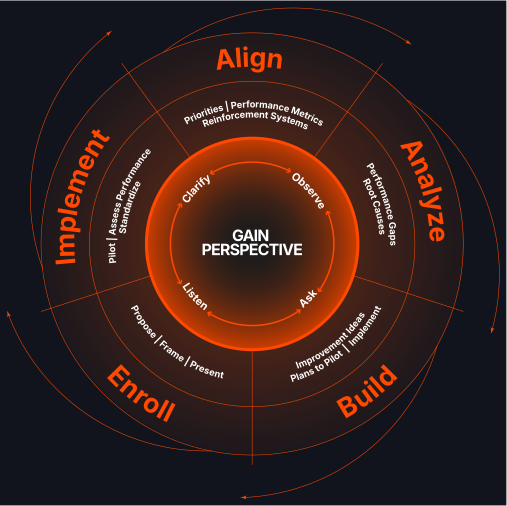
Perspective is not a first step. It is the discipline used before, during and after every Dimension.
It is practiced through four actions that are interrelated, overlapping and continuous.
1 · Observe
Look for the story of what matters
Before mentioning a new way, observe what leaders focus on, measure and reward, both the obvious and the less obvious.
- Leadership messages, annual priorities and public commitments
- What appears on scorecards, dashboards, reports and meeting agendas
- Where time, money and senior attention are allocated
- What receives praise, promotion, recognition or correction
- What people avoid saying directly, but reveal through behavior
2 · Ask
Questions that open the system
Being inquisitive is not a weakness. Thoughtful questions show genuine interest in the organization's success and reveal what observation alone cannot.
- What outcome matters most here, and why now?
- How is success measured at the enterprise, team and individual level?
- What has already been tried, and what did we learn?
- Where does the current process work well?
- Who is most affected by the problem, and by any possible change?
- What would make leadership confident enough to support a pilot?
3 · Brilliant Listening
Listen for meaning, not for words
Brilliant Listening is the highest level of listening we know how to practice: active, generous, empathetic, compassionate and visually attentive. Stay with the speaker instead of preparing your reply. Listen for concerns, values, trade-offs, and what is not being said.
It creates four outcomes at once. You gain knowledge and understanding. The other person feels heard. Respect and trust are established. And you become better able to tell a promising idea from one that is premature or incomplete.
4 · Clarify
Check that what you heard is what they meant
Perspective requires accuracy. Assumptions, past experience and our desire to sound smart can distort what we heard. Clarifying gives the other person a chance to correct our interpretation.
- "When you say speed, do you mean response time or time to market?"
- "Let me reflect back what I heard."
- "Which part is most important to you?"
- "What am I missing?"
Not knowing is fine. Pretending to understand is expensive.
The four traps that make listening weaker
Most people are not poor listeners because they do not care. They are poor listeners because their attention is busy.
You hear enough to respond, but not enough to understand the speaker's full meaning.
You assume this situation is the same as one you have already experienced.
You evaluate the person or the idea while they are still speaking.
You focus on appearing quick, intelligent or prepared rather than becoming informed.
A reset you can use in the moment
- Pause. Notice whether you are preparing, defending or judging.
- Return your attention to the speaker's words, tone and context.
- Ask one clarifying question before offering your point of view.
- Confirm the meaning and the next step before the conversation ends.
Listening is not waiting for your turn. It is how you discover the system.
What the discipline builds
You see more of the system: what is being measured, where work gets stuck, which risks matter, and what has already been tried.
People feel heard and respected. Trust grows before you ask them to consider a new way.
You become better able to distinguish a promising idea from one that is premature, misaligned or incomplete.
The stronger your ability to get someone's world, the stronger your ability to influence, because your idea begins to sound like help rather than judgment.
Connect your idea to what matters most.
The path to influence begins with being crystal clear about what the organization and its leaders care about most. A new idea is important only when it contributes to something the organization is already trying to achieve. Three things have to be understood, and they are not interchangeable: the priorities receiving leadership attention, the performance metrics that show movement against them, and the reinforcement systems that decide what behavior actually happens.
The third is the one people skip. A stated priority tells you what an organization says it wants. What is rewarded, promoted, funded or corrected tells you what it will do.
Can you draw a clear line from the idea to a priority, from the priority to a metric, and from the metric to the behavior the organization is reinforcing? If not, the idea may be interesting, but it is not yet aligned.
Alignment makes the idea relevant before it makes the idea impressive.
Align in full, with a worked example and a case lensUnderstand the real issue with others.
All successful ideas for change are grounded in fully understanding the current system. Once the idea is aligned with a real priority, the analytical work begins, and this is where many promising efforts become too private. Someone develops a theory, gathers only the evidence that supports it, and presents a conclusion to people who were never included.
The people closest to the work hold information that the data, the org chart and the ambitious intrapreneur do not. Including them improves the quality of the analysis and begins building shared ownership before a recommendation exists.
The work itself is disciplined rather than intuitive. Identify the performance gap. Stratify the data, because averages tell you that something is happening while stratification tells you where and for whom. Then move from symptom to root cause, remembering that a root cause is not simply the last why someone says in a meeting. It is a contributing condition that, when addressed, is reasonably expected to improve the gap.
Analyze in full, including the five-step sequence and root-cause testsDevelop a credible, actionable recommendation.
Every new way depends on others. Inclusion is not a step in the process, it is the process. Once the root cause is credible, the work turns to building possible remedies, and this is not the moment to protect the first idea. It is the moment to open the field, involve people with relevant experience, and create enough options to learn what a strong recommendation really looks like.
Then evaluate through the eyes of the people who will decide. Alongside cost-benefit and risk-return analysis, weigh the needs of different stakeholders, leaders' varied appetites for change, timing within the fiscal year, brand risk, and how risk would be mitigated. Finish with a bounded path to pilot, because a proposal becomes more credible when it includes a way to learn.
Thinking ahead is rarely viewed as a negative by those in power. Over-planning an unapproved idea can be.Build in full, with the disciplined brainstorm and the path to pilot
Build the trust and clarity to move the idea forward.
Enrollment is not about selling an idea. It is about sharing a new way so clearly and credibly that others can see a better future and trust it enough to act. The Journey moves away from the language of the pitch deliberately, because leaders generally do not want to feel they are being sold something, especially when sponsoring it puts their credibility and reputation at stake.
The central question a leader is answering is rarely "is this interesting?" It is "do I trust enough to change?"
Trust grows when leaders can follow the logic and believe the recommendation is grounded in reality. Those are two separate things. Clarity is whether they can understand the problem, the root cause, the recommendation, the expected impact and the path forward. Believability is whether they think the work is complete enough, the evidence sound enough, the team capable enough, and the risks understood enough. Together they produce the confidence to change.
The strongest proposal reduces uncertainty without pretending uncertainty has disappeared.
Turn the new idea into shared action.
Leadership approval is the end of one part of the Journey and the beginning of another. Many excellent proposals fail, not because of the idea, but because the plan does not prepare the people and the system to make the new way work.
Approval does not remove resistance. It changes who must now understand, trust and own the new way. The people who were persuaded are rarely the people who have to live with the change, and the second group did not have the conversation the first group had. So the first task is not a launch date. It is to gain the perspective of the people who will carry the change, be measured by it, support it, or experience its effects.
From there the work is communication, preparation, training, performance measures, feedback loops, reinforcement systems, timelines, and usually a pilot. A pilot is not a smaller launch. It is a disciplined learning environment: pilot, assess performance, decide, then iterate or standardize so the new way becomes the standard way.
Implement in full, with the pilot cycle and a worked exampleWhy Dimensions, and not steps
The word Dimensions, rather than steps, better conveys the connected and cyclical nature of the Journey. Each Dimension has clear things to do, but there is also some back and forth as you progress. There is a start and a finish, and there is continued referencing and confirming throughout, so it is better not to define the Journey as linear.
Within each Dimension there are prescriptive things that must happen. The how-to reflects each organization's own preferred processes, methods, models and practices, which is what makes the framework complementary to what a company already uses rather than a replacement for it.
What holds it together is the anchor. Gaining Perspective is not the first Dimension you complete and move past. It runs underneath all five, because any new idea has to start with a full understanding and appreciation of today. And a completed cycle is not the end: a new way becomes part of organizational history, and scaling it may require another Journey.
The framework in one line each
- Gain Perspective. Understand other people's worlds.
- Align. Connect your idea to what matters most.
- Analyze. Understand the real issue with others.
- Build. Develop a credible, actionable recommendation.
- Enroll. Build the trust and clarity to move the idea forward.
- Implement. Turn the new idea into shared action.
Where to start this week
The framework is large. The entry point is not.
You do not need a project, a mandate or a slot in someone's calendar to begin. Gaining Perspective is the only Dimension that requires nothing from anyone else, which is why it is the anchor and why it is where everyone starts.
Take one idea you have already tried to move and could not. Then answer these about the person you were trying to influence, honestly, and count how many you cannot answer.
- What are their three most important priorities right now?
- How is their performance measured, and what are they held accountable for?
- What pressure are they getting from their own leadership?
- What has already been tried in the area you want to improve, and what happened?
- What risk would they personally carry if your idea did not work?
- Who else would they need to involve or convince?
Most people cannot answer four or more, and that is the finding. It is not evidence that your idea was weak. It is evidence that the idea was the only part of the problem you had worked on.
Pick the question you least want to ask, and ask it. Not as a preamble to your proposal, and not in the same meeting. Ask it, listen without preparing your reply, and clarify what you heard before you leave.
That is the whole method in miniature. Everything else in the framework is the same discipline applied at greater scale, with more people, and against a larger decision.
What tends to change first
- Fewer conversations that go nowhere, because fewer of them start with a conclusion
- Ideas that come back with questions rather than silence
- A clearer sense of which of your ideas is actually ready and which one is not
- Over time, a reputation as someone whose proposals are worth reading
None of that requires authority. All of it makes the next request for authority easier to grant.
Go deeper on any Dimension
Each has its own page, with a worked example, a case lens read from the public record, and the specific tools that Dimension uses.
Take the framework into your organization
The complete Intrapreneurship Journey, with the four actions, the five Dimensions and the worked examples, delivered as Intrapreneurship Foundations across five weeks, a two-day Intensive, or a custom Accelerator running two to three months on a live opportunity, adapted to your priorities and your cases.
See the three formatsCommon questions
- What is the Intrapreneurship Journey?
- A practical framework for moving a new idea forward inside an organization you do not own. It is anchored in Gaining Perspective and moves through five Dimensions: Align, Analyze, Build, Enroll and Implement.
- What is intrapreneurship in simple terms?
- Acting like an entrepreneur inside a company you do not own. Seeing something that could work better, and taking responsibility for moving that change forward, usually before you have the authority to simply make it happen. It is not a job title. It is a way of contributing, and it happens in operations, technology, finance, HR, customer service, marketing, healthcare, education and almost any other function.
- Can you give an example of intrapreneurship?
- Someone in a customer-facing team notices that returns are concentrated among first-time buyers of one product line. Rather than proposing a redesign, they check whether returns connect to a company priority, ask the people closest to the work what they are seeing, find that the cause is confusion about fit rather than product quality, build several options with the team, and propose a six-week pilot of the cheapest one with a clear measure of success. That sequence is intrapreneurship. The idea is the smallest part of it.
- What is Gaining Perspective?
- Getting other people's worlds. Understanding what leaders and colleagues are responsible for, what they are measured by, what pressures they carry and why the current way exists, before proposing a different one. It is practiced through four actions: Observe, Ask, Brilliant Listening and Clarify.
- Is the framework a linear process?
- No, which is why the five parts are called Dimensions rather than steps. There is a start and a finish, but there is continued referencing and confirming as you go, and Gaining Perspective runs underneath all five rather than being completed first.
- Does it replace the methods we already use?
- No. Within each Dimension there are things that must happen, but the how-to reflects each organization's own processes, models and practices. The framework is designed to be complementary rather than a replacement.
- Where does AI fit?
- AI can surface patterns, draft options and accelerate analysis. It cannot understand the lived reality of the people inside a system, make trade-offs across constituencies, earn trust, or create shared ownership. AI expands what is possible. The Journey is what turns a possibility into something an organization adopts.
- Who is the framework for?
- People who can see how their organization could work better and who do not yet control the budget, the authority or the final decision. Emerging leaders, new managers, high-potential employees, and people working in strategy, operations, product, innovation, technology, transformation and social impact.
- Where can I practice it?
- The Intrapreneurship Foundations cohort runs five weeks, as one two-hour orientation plus eight two-hour sessions, practicing the full Journey on a realistic business case and then on a real situation from your own job. Organizations can also run it internally in one of three formats.