 By
Intrapreneurship is the practice of developing and putting new ideas into action within an existing organization. It can mean improving a product, a service, a process, or the way people work together. In our work, an intrapreneur is someone who learns to lead that change from within. They see an opportunity to make things better, understand what matters to the organization, and work with others to turn that opportunity into action.
In this article
- I expected the idea to speak for itself
- Intrapreneurship vs. entrepreneurship
- Why intrapreneurship matters now
- Starbucks Example: The system looks different from behind the counter
- Brent’s perspective on making things easier and better
- Intrapreneurship is a Career Accelerator
- A culture that makes contribution possible
- How to begin your intrapreneurship journey
I learned how much that takes through an idea I was certain my organization needed.
I expected the idea to speak for itself
When I joined Ashoka, the organization that has pioneered social entrepreneurship, I was bursting with ideas. I wanted to contribute. I wanted to create impact. I was ambitious. And everywhere I looked, I could see possibilities.
This is familiar territory for me. I can walk into a café and start thinking about how the experience could be better. At Ashoka, where I would spend eight years and eventually work closely with founder Bill Drayton, that same instinct had found a much bigger home.

One question kept drawing my attention. Changemaking was central to our work, and I wanted to understand more clearly how people began that journey and how they grew along the way.
I recruited interns through a partnership with Brigham Young University’s Ballard Center. Together, we interviewed more than 50 changemakers, looking for patterns in their experiences. From those insights, I developed a Changemaker Journey.
By the time I brought it to Bill, I was excited. We had done the research. We had found something useful. I could see so many ways it might help our work.
Bill responded warmly and thanked me. But the work did not go much further. I kept trying to move it forward, became frustrated, and eventually gave up. At the time, I thought it was only their fault.
Looking back, I understand the situation differently. I had arrived with a substantial, largely finished framework. I had not involved enough of the leaders and colleagues who would need to use it, and I had not tied it to a specific organizational priority. I was essentially saying it would help everything, without making clear what it would help first.
I was so focused on the possibilities that I had given too little thought to what adoption would ask of other people. They might need to reconsider established approaches, change how they worked, and find time for something they had not helped develop. I had left too much of that work for them to figure out.
Years later, Ashoka’s president contacted me to say that my changemaker journey framework was proving useful and could have helped earlier. I was glad to hear it. I also wished I had known then what I understand now.
I would have invited people into the work much sooner. I would have asked which problem they needed help solving and shaped the research around a clear use. We could have explored a manageable first application together.
The idea had value. I needed to learn how to help it become useful inside the organization. That is the intrapreneurship journey.
Intrapreneurship vs. entrepreneurship
The word intrapreneurship sounds so much like entrepreneurship that the two are easily confused. The distinction is where you build: an entrepreneur develops a venture, while an intrapreneur works within an existing organization, with its people, priorities, and resources.
The term is commonly traced to a 1978 paper by Gifford and Elizabeth Pinchot. Gifford developed the concept further in his 1985 book, Intrapreneuring: Why You Don’t Have to Leave the Corporation to Become an Entrepreneur.[1]
New products and businesses are important expressions of intrapreneurship. Its scope also includes better services, processes, and ways of working, as Pinchot’s early writing recognized.[2] A useful contribution might begin with something as ordinary as a customer repeatedly having to explain the same problem to different departments.
This is the possibility that interests me: people throughout an organization learning how to make it better. The person handling those customer conversations has knowledge. So does the colleague using a process that creates unnecessary work. Their experience can become the starting point for a change worth making.
Free guide
Get the free framework
Download our 12-page guide to The Intrapreneurship Journey and explore an approach to developing ideas and building support at work.
Download the free frameworkWhy intrapreneurship matters now
We ask a great deal of the people leading organizations. They have to respond to new technologies, changing expectations, and competing demands on time and money. It is unrealistic to expect that same group to see every problem and come up with every useful improvement.
The work itself is changing. In the World Economic Forum’s Future of Jobs Report 2025, surveyed employers expected an average of 39 percent of workers’ existing skills to change or become outdated between 2025 and 2030.[3] Learning new skills also means figuring out how to put them to work in a particular team, with particular customers and constraints.
That is why I believe intrapreneurship matters now more than ever. We need the individual and collective intelligence of the whole organization. We need people who can notice what is happening, investigate it with others, and help the organization respond.
A good idea can begin anywhere. Giving it a fair chance requires a way for people to develop it, test it with support, and connect it to the priorities of those who can say yes.
Starbucks Example: The system looks different from behind the counter
Consider the experience of a Starbucks barista. A mobile order may look wonderfully convenient to the person placing it. Behind the counter, it joins all the other orders arriving at once, including those from customers standing in the café.
In January 2025, Starbucks CEO Brian Niccol described that problem: surges of mobile orders could leave drinks waiting for customers who had not yet arrived, while people already in the store waited for service. Starbucks was testing changes to order sequencing to improve the experience.[4]
For the barista, this is a human situation as well as an operational one. Someone is waiting. The handoff area is crowded. There is pressure to work faster, while the welcome and personal connection that help make a coffeehouse worth visiting become harder to offer. Baristas experience that tension directly, in conversations with customers throughout a shift.
To me, this illustrates why the skills and culture of intrapreneurship belong together. Employees need the skills to investigate what they see and make a compelling case for change. Leaders need to make room to listen and support a test. Together, those conditions can help an organization respond to problems earlier. Starbucks later said its Green Apron Service model was built with employees’ input.[5] There is so much an organization can learn when the people doing the work help shape the efforts to make it more effective.
Brent’s perspective on making things easier and better
Brent Martini is a former Fortune 50 executive and former president of Bergen Brunswig Drug Company. He is also my partner in developing The Intrapreneurship Journey. I value his perspective because he has been the person deciding which ideas receive attention, resources, and support.[6]
Edited from our conversation for length and clarity.
Brent: I think it starts with something very simple: people want things to work better. A little bit better or a lot better. Easier to use, less costly, more satisfying. We want that in our own lives, and we notice opportunities for it in the places where we work.
There are people inside companies everywhere who have that inclination. They see something and think, “This could be a little bit better.” That is a good reason to be an intrapreneur: you care about an improvement and want to help make it happen.
For an organization, the opportunity is to help those people turn what they notice into recommendations that can be acted on. An improvement might make a process simpler, save someone time, or make an experience more pleasing. Some ideas are small. Some are big. What matters is helping useful ideas get done.
The part I want to help people with is how they think about an idea before they bring it forward. First, I need to understand the perspective of the person I am asking to support it. What matters to them? What might make them resistant? What is in it for them?
The benefit might be less effort, less pressure, a lower cost, or less anxiety. I need to understand that benefit from their point of view and make it clear. Something that seems obvious to me may not yet be obvious to them. When they can see how a change would make things better for them, they have a reason to consider it.
If I am going to sponsor a new way of doing things, I need to understand how it aligns with our priorities. Who was involved in developing it? What work was done before arriving at the recommendation? Does it address the root cause, and is the return worth the investment and risk?
That is what I want The Intrapreneurship Journey to help people practice: thinking an idea through so that it resonates with someone else. Little ideas getting done. Big ideas getting done. Making things easier and better for the people around us.
Intrapreneurship is a Career Accelerator
If you are ambitious and see ways your organization could improve, you do not have to wait for a bigger title to begin learning how to contribute. Doing your job well builds trust and can help you progress steadily. Helping improve how the work gets done gives people another reason to trust you with responsibility and can open doors beyond your current role.
That takes effort and judgment. It means understanding someone else’s priorities, taking feedback seriously, and being willing to change your idea as you learn. Career growth is not guaranteed, but these are capabilities you can develop and carry with you.
A culture that makes contribution possible
Organizations have a part to play too. I want leaders to welcome the person who says, “I think we could do this better.” That can be uncomfortable, especially when the suggestion challenges something the leader helped create. Listening with curiosity gives people room to explain what they see and gives leaders a chance to learn something they may have missed.
People also need practical support: time to investigate, access to the people involved, and clear permission to test a possible improvement. A small experiment with an agreed purpose and boundaries gives both the employee and the manager something concrete to learn from. If someone is already stretched, their manager needs to help decide what can wait. Improving the organization should count as part of the work.
The incentives matter just as much. If we measure people only by how quickly they complete today’s work, we make it difficult for them to spend time improving tomorrow’s. Our measures and rewards should recognize useful learning, collaboration, and improvements that serve our priorities. That could mean recognizing this contribution in a performance conversation, offering a development opportunity, or giving someone responsibility for the next step. Counting how many ideas people submit tells us very little about what those ideas contribute.
And people need to know what happened to their contribution. Give thoughtful feedback. Explain why an idea will move forward, needs more work, or will wait. Recognize the people who helped develop it and share credit when it succeeds. Even when a careful test shows that an idea will not work, acknowledge what the team learned. These everyday responses help people decide whether speaking up and making the effort will be worthwhile.
How to begin your intrapreneurship journey
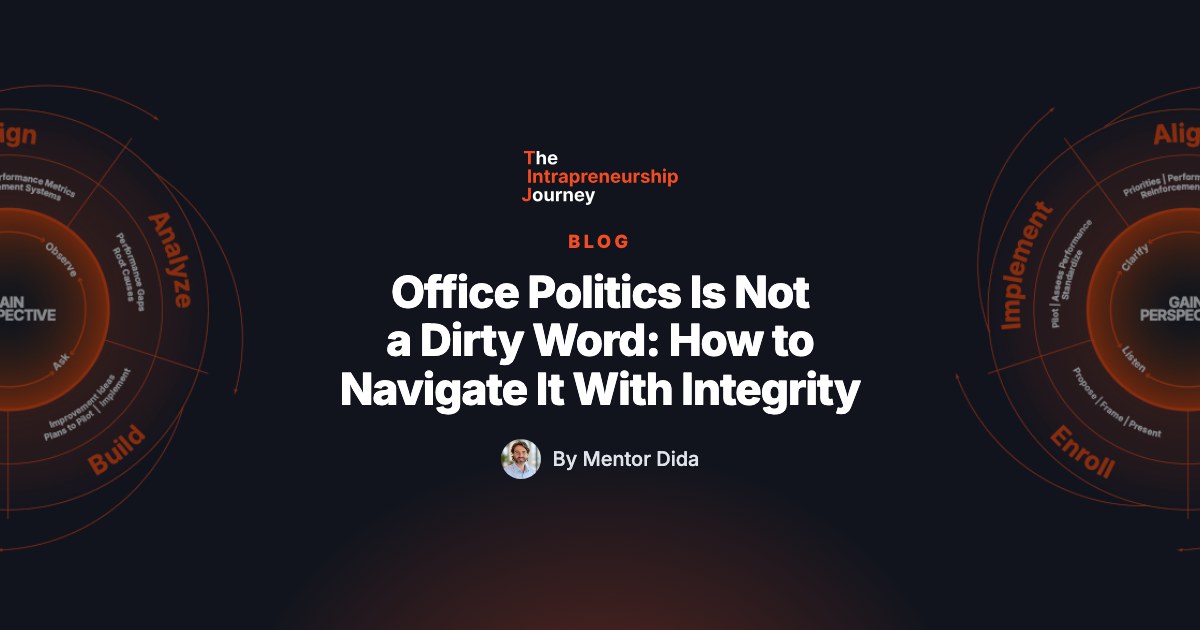
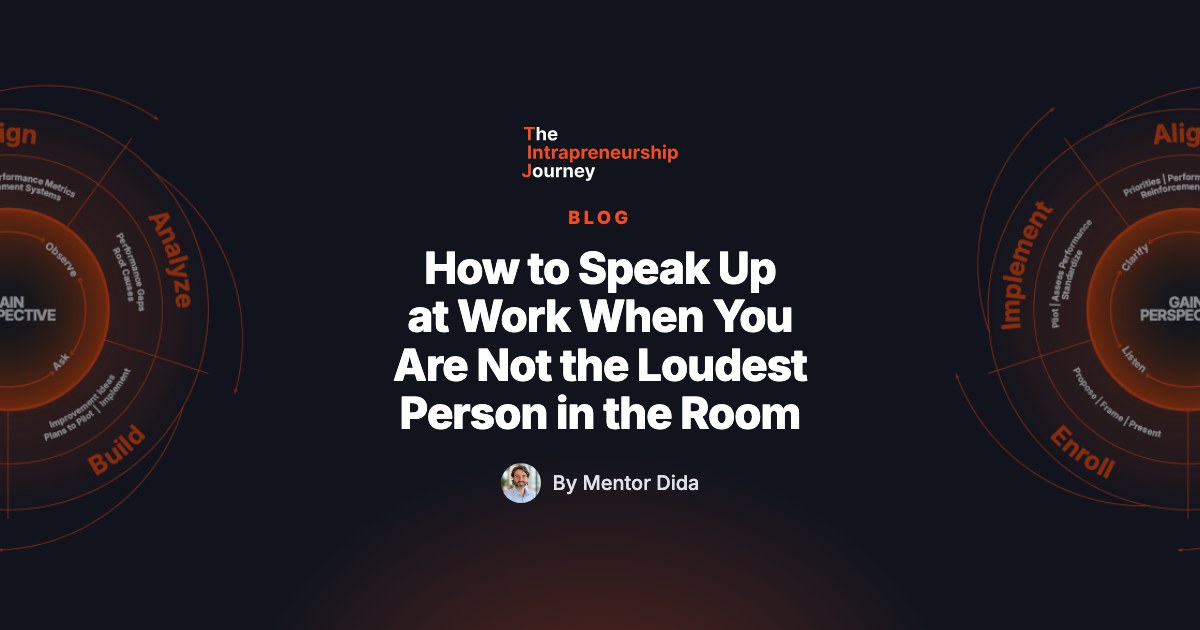
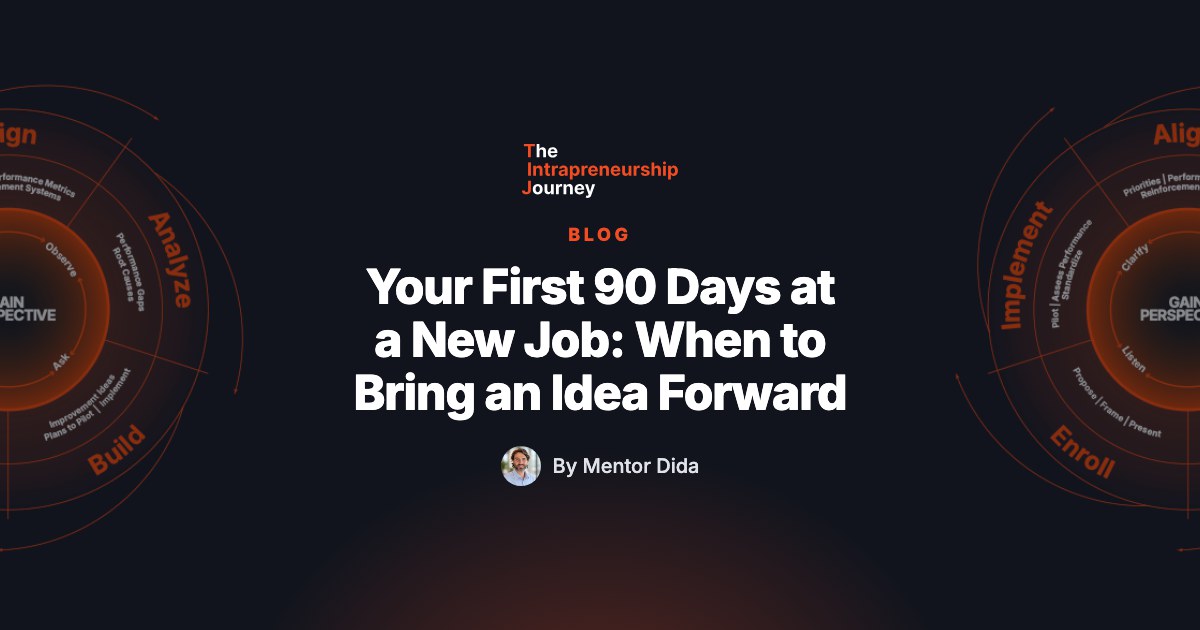
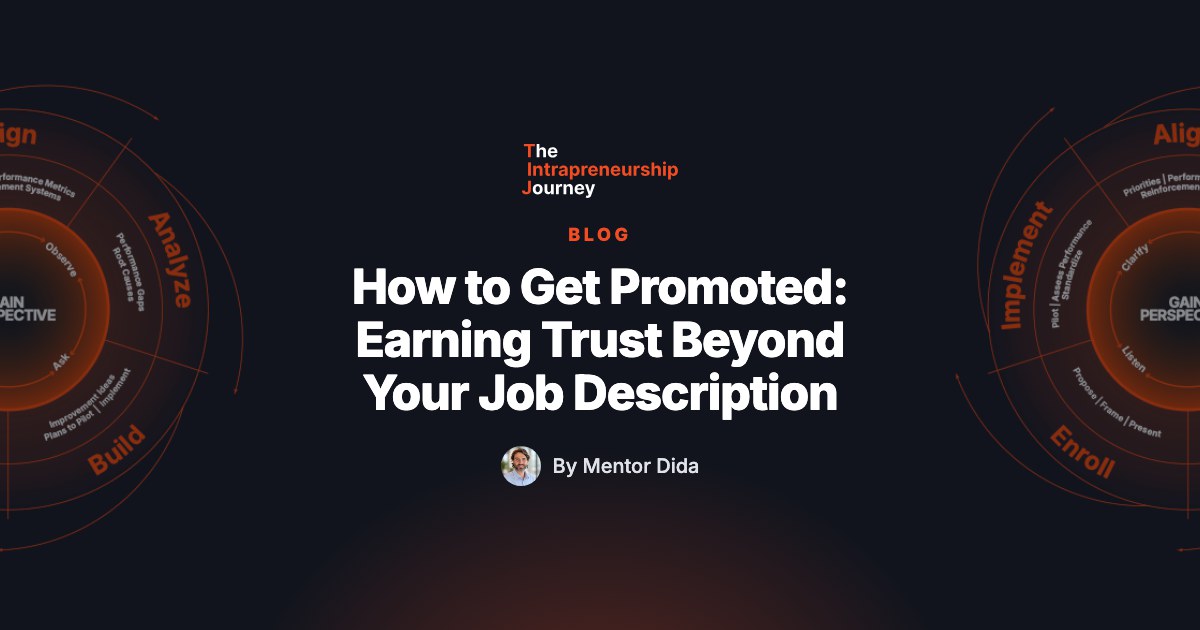
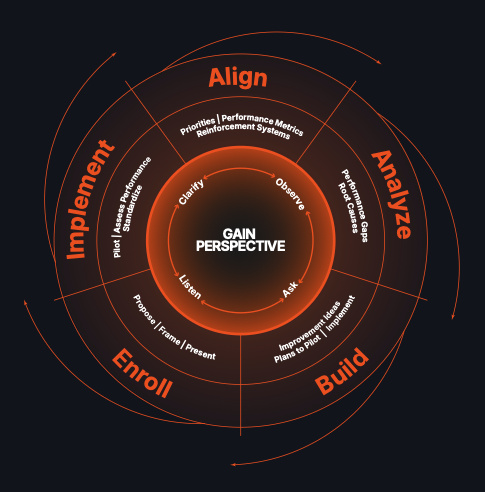
Brent Martini and I developed The Intrapreneurship Journey to help people do this work. At its center is Gaining Perspective: observing, asking thoughtful questions, listening to learn, and clarifying shared understanding.
Looking back, I can see how differently my Ashoka project might have unfolded if I had practiced that discipline from the beginning. I would have understood more about the people I hoped to influence and what it would take for them to use the work.
Gaining Perspective continues across five connected dimensions. In Align, we connect the idea to organizational priorities, metrics, and what gets rewarded. In Analyze, we work to understand the performance gap and its root causes.
In Build, we develop options with others and consider the value, resources, and risks involved. In Enroll, we help the people whose support we need understand the recommendation and have confidence in it. In Implement, we put the idea into practice, assess what happens, and adapt.
Each dimension helps us do justice to the people and the system we are asking to change. A new idea can affect someone’s workload, responsibilities, or confidence in what comes next. Taking those realities seriously is part of making a compelling recommendation.
Start with one recurring problem you see in your work. Speak with someone affected by it and someone responsible for the relevant priority. Listen for what each understands that you may have missed. Find out what has already been tried and what a useful improvement would look like.
That is where I would begin if I were starting my Ashoka project again: by inviting people into the work early enough for their perspective to change it. You can begin there too, learning to influence those in power before you are in power.
Sources
- Gifford Pinchot, Four Definitions for the Intrapreneur. First-person account of the 1978 paper and 1985 book.
- Gifford Pinchot, Innovation Through Intrapreneuring. Originally published in Research Management, March–April 1987.
- World Economic Forum, The Future of Jobs Report 2025, Key Findings, 7 January 2025. Employer expectations for 2025–2030.
- Starbucks, Q1 2025 earnings call, 28 January 2025, transcript pages 18–19. Brian Niccol on mobile orders and sequencing.
- Starbucks, Message from Brian: Green Apron Service, One Month In, 8 September 2025. Employee involvement in development.
- The Intrapreneurship Journey, Meet Brent Martini. Biography and former corporate leadership roles.