 By
In your first 90 days at a new job, you do not have to wait for a set date to contribute. You can start asking about what you notice in your first weeks. Before you ask anyone for a decision, do enough work to match what you are asking for: know which priority the idea supports, what has been tried before, and what the people closest to the work think. The question is not how long you have been there. It is this: have I done enough work for the next step I am asking people to take?
In this article
- The idea I raised before it was ready
- When is it safe to suggest changes at a new job?
- What should I do in the first 90 days of a new job?
- How do I start a new job?
- How long should it take to adjust to a new job?
- How do I find out why things are done this way, and what was tried before?
- Brent’s perspective on ideas from someone new
- What are common mistakes in the first 90 days?
- How to bring an idea forward in your first 90 days
- Try it in your next one-on-one
I learned that in a meeting where I spoke before my idea was ready.
The idea I raised before it was ready
For me, the journey begins before you bring an idea to anyone. It begins with giving yourself permission to contribute.
You notice an inefficient process or an opportunity to improve something, and a question comes up: “Is this my job?” An intrapreneur gives themselves permission to explore how they could help, even when the opportunity extends beyond their job description. That means taking responsibility for learning and contributing. It does not automatically give you the authority to change someone else’s work.
The next responsibility is to take your idea seriously enough to do some homework. I learned this while working at a consultancy in Washington, D.C., on a White House AI initiative. During a call with a White House representative and a GSA manager, I noticed something I thought could be improved. When my turn came to give updates, I spontaneously suggested that we consider another approach.
There were two problems. The team already had its tasks and direction in place, and my suggestion could have challenged that direction. Also, when people asked questions, I had not thought the idea through enough to answer them well. An idea I believed had potential came across as a surface-level suggestion.
Looking back, I would have written it down, explored it with relevant colleagues, and understood what changing direction would mean before bringing it into that meeting.
An idea needs enough substance for people to engage with it. It does not need to be perfect, but you should be able to explain why it deserves attention and what you have done to understand it. When you are new, you are doing that work with less context than the people around you.
When is it safe to suggest changes at a new job?
You can raise what you notice from your first weeks, as long as you raise it as a question. What decides the rest is how much you are asking of other people, and how much work you have done to support it.
Being new has value. You see the organization with fresh eyes. You also have the least context, and colleagues who are often more experienced “would like to be listened to first before listening to new ideas from someone else,” as our framework guide puts it. What matters to leaders is “sometimes obvious, sometimes not,” and someone new has had the least time to find out which.
So yes, an idea can be brought forward too early. But I would judge that by your understanding, the timing, and what you are asking people to commit to. I would distinguish between three situations:
- Raising an observation. You can begin asking thoughtful questions early. “I noticed this happens regularly. Can you help me understand why?” You are opening a conversation and gaining perspective.
- Exploring an idea with colleagues. You have noticed something worth investigating and want others to help you understand it. Be clear about what you know, what you are assuming, and where you need their experience.
- Asking for approval or resources. You are asking someone to commit time, money, people, or a change in direction. That deserves more preparation.
Timing also includes what is already happening around you. A strong idea can still arrive when the team has no capacity to act on it. Understanding the meeting’s purpose and the commitments already made is part of Gaining Perspective.
Free guide
Get the free framework
Download our 12-page guide to The Intrapreneurship Journey and explore an approach to developing ideas and building support at work.
Download the free frameworkWhat should I do in the first 90 days of a new job?
Learn actively. Understand priorities, build relationships, explore previous attempts, and develop opportunities with others.
Much of the advice on this period is built around the 30-60-90 day plan, which divides your first three months into stages, often learning first, then contributing, then delivering. A plan like that is useful for organizing your own work. For ideas, I would avoid prescribing a universal day when people are finally allowed to contribute. Readiness depends on the idea and on what you are asking for, not on the calendar.
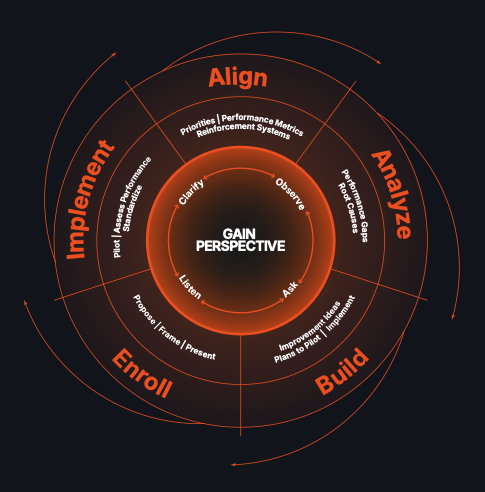
In our framework, the practice for these months is Gaining Perspective. It has four actions:
- Observe what leaders focus on, measure, and reward, both the obvious and the less obvious.
- Ask thoughtful questions to deepen understanding of processes and people.
- Listen brilliantly to learn, absorb, and appreciate, but not simply to answer.
- Clarify that what you heard is what they meant.
Our guide also asks you to be “sensitized to how employees and associates are doing.” Their confidence, concerns, and frustrations will shape how any idea of yours is received.
How do I start a new job?
The usual advice for starting a new job is sound: meet your manager, clarify what is expected of you, introduce yourself, and take notes. If you want to contribute beyond your role, add two things.
First, learn what your team is trying to accomplish and how it is measured. In our framework this is Align: being clear on what is truly important to leaders, how they are performing against the targets tied to those priorities, and what gets rewarded. Our guide puts the test simply: “The best new idea is one that clearly has a line of sight to contributing to existing priorities. If not, it is probably not worth pursuing.”
Second, write down what you notice. When something looks like it could work better, note what you saw, what you do not yet understand, and which priority it might affect. Then hold it while you learn. Some notes will turn out to have a good reason behind them. Others may become a useful contribution.
How long should it take to adjust to a new job?
There is no standard answer, and I would not set a date. For bringing ideas forward, a better test is whether you can answer what Brent Martini looks for first, in his section below: what the team is trying to accomplish, who does the work, why the current approach exists, and whether your suggestion has been tried before.
This applies even if you arrive with years of experience elsewhere. What you learned there helps you notice, but it does not yet tell you why things work as they do here.
You do not need every answer before you start a conversation. You do need them before you ask for a decision.
How do I find out why things are done this way, and what was tried before?
Ask, in a way that invites the history rather than challenging it. You can do that in your first weeks: say what you noticed, and ask for help understanding why it works the way it does.
Our guide offers a principle for these conversations: “how about starting first with where they are, why they are doing something, what is important to them, what they are working to accomplish, and what it would mean for them to comply, agree, or change?”
Before asking for a decision, I would want to understand which priority the idea supports, what evidence points to the problem, what has been tried before, and what the people closest to the work think. Where there is a performance problem, we need to investigate its root causes rather than assume our first explanation is correct. In our framework, that is the work of Analyze.
Ask with care. Your suggestion may challenge something a colleague or your manager helped create, and asking about the history first shows respect for the people who built it.
Brent’s perspective on ideas from someone new
Brent Martini is a former Fortune 50 executive and former president of Bergen Brunswig Drug Company. He is also my partner in developing The Intrapreneurship Journey. He has been the person deciding which ideas receive attention, resources, and support.[1] Here is his answer to what makes an idea from someone new feel welcome rather than premature.
Edited for length and clarity.
Brent: Being new can be an advantage. You bring a fresh perspective, and you may notice something that people have stopped questioning. But you also have less context. Both things can be true.
The first thing I would look for is whether you have made an effort to understand what you are walking into. Do you know what the team is trying to accomplish? Have you talked with the people doing the work? Do you understand why the current approach exists and whether someone has tried your suggestion before?
You do not need all those answers before starting a conversation. Asking for perspective is part of doing the work. Share what you are noticing, explain what you do not yet understand, and invite others to help you think it through.
What makes an idea feel premature is arriving with the answer before understanding the problem. If your suggestion would change someone’s work and you have not involved them, there is more work to do.
When you ask for a decision, help me understand what I am being asked to support. What problem are we solving? How does it connect to our priorities? What evidence supports the approach? Who has helped develop it?
Then show me how we could move forward. That might be a small test with a clear owner, manageable cost, and a way to judge the result. You do not need to predict everything. You do need to show that you have thought beyond getting someone to agree.
I would also pay attention to how you involve your direct manager. Before taking an improvement idea over their head, bring them into your thinking. Understand what they are accountable for, where they need help, and how your idea could support their success.
A useful way to start that conversation is: “I noticed something that might help us with this priority. I’d like your perspective before I take it further. What am I missing?”
That shows maturity. You are giving your manager an opportunity to contribute, challenge your assumptions, and help shape the next step. They may see constraints you have not encountered yet, or help you bring the idea to the right people.
Helping your manager and team succeed is a strong expression of initiative. You are showing that you can work with people, share ownership, and build support for something worth doing. Those are qualities I would want to see in an emerging leader.
What are common mistakes in the first 90 days?
I have made some of these myself.
- Bringing an idea into a meeting before you can answer questions about it. That was my mistake on the White House AI call. The idea may be good, but it arrives as a surface-level suggestion.
- Arriving with the answer before understanding the problem. Brent names this as what makes an idea feel premature.
- Changing someone’s work without involving them. At Ashoka, as I described in what intrapreneurship is and why it matters, “I had arrived with a substantial, largely finished framework. I had not involved enough of the leaders and colleagues who would need to use it, and I had not tied it to a specific organizational priority.”
- Going over your manager’s head. As Brent advises, bring your manager into your thinking first. They may see constraints you have not encountered yet.
- Asking for more than your preparation supports. A question needs curiosity. A request for time, money, or people needs evidence and a plan.
- Waiting for a date when you are finally allowed to contribute. Giving yourself permission to explore is where this starts.
How to bring an idea forward in your first 90 days
Here is how to suggest improvements at work while you are still new.
- Give yourself permission, and write it down. Note what you saw, what you do not yet understand, and which priority it might affect.
- Ask before you suggest. “I noticed this happens regularly. Can you help me understand why?” Listen for the history and for what has been tried before.
- Connect it to a priority. If you cannot see a line of sight to something the organization is already working toward, keep learning before you take it further.
- Develop it with others, starting with your manager. Explore it with the people closest to the work and the people whose work would change. Invite them to challenge it.
- Match the preparation to the request. A small experiment may need a clear owner, a limited scope, an estimate of effort, and a measure of success. A larger investment needs a more developed case, including costs, benefits, risks, and expected return. Either way, answer four questions: Who would be involved? What would it take? What value could it create? How would we know whether it worked?
These steps follow The Intrapreneurship Journey, the framework Brent and I developed. Gaining Perspective sits at the center and continues across five connected dimensions. In Align, we connect the idea to organizational priorities, metrics, and what gets rewarded. In Analyze, we work to understand the performance gap and its root causes. In Build, we develop options with others and consider the value, resources, and risks involved. In Enroll, we help the people whose support we need understand the recommendation and have confidence in it. In Implement, we put the idea into practice, assess what happens, and adapt.
Try it in your next one-on-one
Pick one thing you have noticed in your first weeks. In your next one-on-one with your manager, use the opening Brent suggests: “I noticed something that might help us with this priority. I’d like your perspective before I take it further. What am I missing?”
Then listen, and write down three things afterward: which priority your manager connects it to, what constraints or history they mention, and who they suggest you speak with next. Their answers will tell you what the next step is, and how much work it needs before you take it.