 By
Influencing without authority means helping an idea move through people you do not manage and decisions you do not make. The way to do it is to start with their world, not your idea. Then make sure you can answer what the person deciding will ask: Does it align with our priorities? Who was involved in developing it? What work was done before arriving at it? Does it address the root cause, and is the return worth the investment? Those are the five things to know before you ask anyone for support.
In this article
- The idea that did not move
- What is the difference between authority and influence?
- How do you influence without direct authority?
- What is the person deciding actually checking?
- How to influence people in leadership?
- What are the biggest mistakes people make here?
- How to start influencing without authority this week
- Try it before your next request
I learned this by getting it wrong.
The idea that did not move
At Ashoka, I brought a framework I had developed to our founder, Bill Drayton. He responded warmly and thanked me. But the work did not go much further.
As I wrote in what intrapreneurship is and why it matters, “I had arrived with a substantial, largely finished framework. I had not involved enough of the leaders and colleagues who would need to use it, and I had not tied it to a specific organizational priority. I was essentially saying it would help everything, without making clear what it would help first.”
I was trying to influence people with more authority than I had, and I started in the wrong place. I started with my idea. I had not yet understood their world: what they were responsible for, what they were measured on, and what saying yes would ask of them and their teams.
The idea is 10% of the work, and the execution is the other 90%. That is what we can forget when we are excited about an idea. We are thinking about how good it could be. The person deciding also has to think about how it will actually happen.
What is the difference between authority and influence?
Authority is the power to decide: the title, the budget, the people who report to you. Influence is the ability to help a decision move when that power belongs to someone else.
As our For Professionals page puts it, “You may not have the title, the authority or the purse strings to just do it yet. You can still learn how to influence.”
There is a reason this is hard. Our framework guide describes what the person proposing an idea “may be blind to, unaware of, or simply not yet know to consider. And why would they? They have not yet occupied the positions of power they are trying to influence.” Influence without authority starts by learning what those positions look like from the inside.
Free guide
Get the free framework
Download our 12-page guide to The Intrapreneurship Journey and explore an approach to developing ideas and building support at work.
Download the free frameworkHow do you influence without direct authority?
Here are the five things I would want anyone to know before they ask someone with more authority to support an idea.
1. Start with their world
Our guide’s closing page puts the core principle this way: before trying to influence anyone, “how about starting first with where they are, why they are doing something, what is important to them, what they are working to accomplish, and what it would mean for them to comply, agree, or change? Getting other people’s worlds first will always serve you well!”
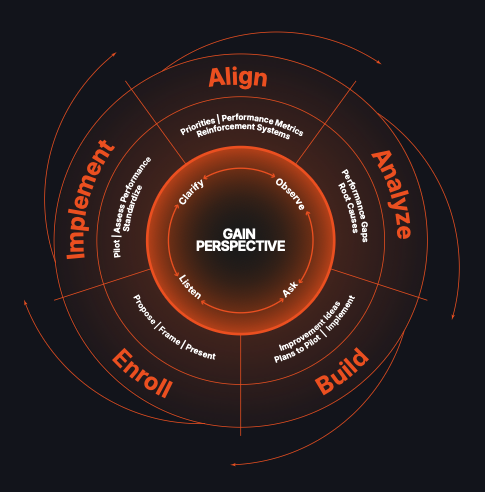
This is not a step you finish and leave behind. Getting other people’s worlds continues throughout the Journey. It is something we keep practicing as we develop the idea, involve others, and move toward implementation. In our framework, that practice is Gaining Perspective: observing, asking thoughtful questions, listening to learn, and clarifying what you heard.
2. Does it align with our priorities?
First you Align. That means understanding the priorities, the metrics used to measure performance, and what the organization reinforces through rewards, recognition, promotion, or consequences. What are people being encouraged to focus on? What are they held accountable for?
That last part is what our framework calls reinforcement systems: what is rewarded, recognized, or discouraged. An idea may sound valuable, but if it pulls people away from what they are measured and rewarded for, we need to understand that tension.
Alignment also includes the leader as a person. Will this help the leader meet their goals, strengthen their performance, or advance in their role? Connect the benefit to the individual leader with the benefit to the organization as a whole.
3. Who was involved in developing it?
Once the alignment is clear, the next question is whether you developed the idea alone or involved others. Did you speak with colleagues? Did you consult people who understand the problem or whose work would be affected? Did you seek different perspectives and use that input to improve the idea?
4. What work was done before arriving at it?
Make the process concrete. How did you identify the problem? What data did you examine? What did you learn from the people involved? Did you look at what had been tried previously and what happened? What evidence led you to this proposed solution?
5. Does it address the root cause, and is the return worth the investment?
Check that your solution addresses the underlying cause of the problem, not just its symptoms. Then look at the case for pursuing it. The financial return matters, including expected revenue impact or cost savings. But the investment also includes staff time, capacity, and other resources, and risk needs to be considered alongside those costs and benefits.
This is also where you show that you have thought about the 90%. Who could help move it forward? What would it require? What could a manageable first test look like? What responsibility are you prepared to take?
What is the person deciding actually checking?
Brent Martini is a former Fortune 50 executive and former president of Bergen Brunswig Drug Company. He is also my partner in developing The Intrapreneurship Journey, and he has been the person deciding which ideas receive attention, resources, and support.[1] Four of the five things above come from how he describes that decision.
Edited for length and clarity.
Brent: No leader can be close to every customer, every process, or every performance gap. People throughout the organization have perspectives I do not have. I want them to bring that understanding forward and connect it to what we are trying to accomplish.
If I am going to sponsor a new way of doing things, I need to understand how it aligns with our priorities. Who was involved in developing it? What work was done before arriving at the recommendation? Does it address the root cause, and is the return worth the investment and risk?
Behind those questions is what a yes costs the person giving it. As our For Professionals page puts it, “The person proposing an idea usually sees its promise. The person being asked to support it must also consider priorities, performance, budgets, risk, timing, customers, employees, implementation, and the consequences if it fails.”
How to influence people in leadership?
I think one of the biggest misunderstandings is assuming that people in power do not care.
When your idea does not get heard, it is easy to think, “They don’t care.” But people in power usually do care. They may be busy, or they may be prioritizing something that matters more to the responsibilities, metrics, and reinforcement systems they are working within. In many cases, it is about whether what you are suggesting aligns with what they need to accomplish.
That is why Gaining Perspective matters. Before deciding that someone does not care, try to understand their world. What are they responsible for? What pressures are they under? What happens if they do not deliver on their priorities? Where does your idea fit into all of that?
You also have to make their job easier. You might bring an idea because you see the possibility. They may hear it and immediately see the heavy lift: the people who need to be involved, the time it will take, the work already underway, and what they will have to take responsibility for if they say yes.
The more you understand their world and do that homework, the easier you make it for them to consider supporting you. You are helping them see how the idea could advance something they already care about, and how you can help make it happen.
Influence also has limits. “No framework can guarantee that every idea will be approved,” as our For Professionals page says. Leaders have their part too. In Brent’s words, “Leadership has a responsibility in that relationship: make the priorities clear, take people’s work seriously, and provide support for well-considered recommendations.”
What are the biggest mistakes people make here?
- Opening with cost. The return matters, but it is not where you start. First you Align.
- Saying it will help everything. That was my mistake at Ashoka. A leader needs to see what it would help first.
- Assuming they do not care. Usually they are busy, or working to priorities and metrics you have not understood yet.
- Forgetting the 90%. If you have only thought about the idea, the person deciding is left to work out the execution alone.
- Treating their world as a one-time step. Priorities shift and new people get involved. Keep gaining perspective as the idea develops.
- Developing it alone. The people whose work would change should help shape the idea before anyone is asked to approve it.
How to start influencing without authority this week
- Name the person and the decision. Who would need to say yes, and what exactly would you be asking them to support?
- Learn their world. Find out what they are responsible for, how their performance is measured, and what they are rewarded for. Ask people who work with them, and listen.
- Check the alignment and the tension. Which of their priorities does your idea serve? Does it pull anyone away from what they are measured on?
- Bring others in. Talk with the people closest to the problem and the people whose work would change. Use what they tell you to improve the idea.
- Plan the 90%. Write down who could help, what it would require, what a manageable first test looks like, and what responsibility you will take.
These steps follow The Intrapreneurship Journey, the framework Brent and I developed. Gaining Perspective sits at the center and continues across five connected dimensions. In Align, we connect the idea to organizational priorities, metrics, and what gets rewarded. In Analyze, we work to understand the performance gap and its root causes. In Build, we develop options with others and consider the value, resources, and risks involved. In Enroll, we help the people whose support we need understand the recommendation and have confidence in it. In Implement, we put the idea into practice, assess what happens, and adapt.
Try it before your next request
Before you next ask someone with more authority to support an idea, write their name at the top of a page and answer three questions about their world: what they are responsible for, what they are measured on, and what saying yes would ask of them.
Then test your answers in one conversation with someone who works closely with that person. Note where you were right, where you were wrong, and what you had not considered. Adjust the idea before you make the request.