 By
Stakeholder buy-in is the support of the people your idea affects and the people who can move it forward. In our work, we call this building support. Start with your manager, so the time you spend on the idea has their blessing. Then look for the people whose responsibilities the idea touches, not only the person at the top, and involve them early enough that they can help shape it. Who you involve, and how you involve them, is part of developing the idea, not a step at the end.
In this article
- I kept taking my idea to the top
- What does “stakeholder buy-in” mean?
- Who do I talk to first, and where does my manager fit?
- How do I identify the stakeholders for my idea?
- What do I do about the person whose job gets harder because of my idea?
- How do I get stakeholder buy-in?
- What are the biggest mistakes people make when building support?
- Try it this week
I learned that at Arizona State University, by taking an idea straight to the top.
I kept taking my idea to the top
I became a Global Futurist in Residence at Arizona State University’s College of Global Futures. My responsibilities included helping the enrollment team grow its numbers, building partnerships with other institutions, and exploring courses and experiences where students could learn how to make positive change. That last part was a big passion of mine.
I had an idea for a course called “Being the Change,” and I kept throwing the idea at the dean. I was thinking that she had the ultimate power to make the decision, so that was where I kept directing my attention.
The dean was supportive, but the idea was not really moving forward.
Things changed when the vice dean, who had responsibility for the academic side, saw the idea and supported it. She saw how it could fit and advocated for giving me the opportunity. The dean then supported it enthusiastically.
I had been going straight to the top without fully understanding who was responsible for that particular part of the work. Fortunately, I kept having conversations and eventually connected with the person whose responsibilities were directly relevant to the course. Her involvement helped move it forward.
Knowing who can formally say yes is only part of understanding how an idea moves through an organization.
What does “stakeholder buy-in” mean?
A stakeholder is anyone your idea affects or who has a say in whether it happens: your manager, the colleagues whose work would change, the person responsible for that area, and the people they trust. Buy-in is their support, not just their permission.
We use a different word for it. In The Intrapreneurship Journey, this is Enroll: helping people understand a recommendation, trust it, and choose to support it. Our framework guide describes what that looks like when it works: leaders “see the opportunity, trust the work and the team, and feel confident enough to act.”
That is why we avoid treating support as something you secure at the end with a strong presentation. You build it while the idea is still taking shape.
Free guide
Get the free framework
Download our 12-page guide to The Intrapreneurship Journey and explore an approach to developing ideas and building support at work.
Download the free frameworkWho do I talk to first, and where does my manager fit?
Ideally, you want to start with your manager.
If you are going to spend time and energy investigating something, look through data, or ask other employees to get involved, it is good to bring your manager into the thinking early. Share what you are observing, what you are noticing, and what you think might be worth exploring. Get their blessing to get started.
At the same time, you can informally check in with colleagues before that conversation. Maybe you have noticed something and want to understand whether other people are experiencing it too. Those conversations can help you make the initial case to your manager: “Hey, other people share this observation as well. I think it could be worth looking into.”
There is a difference between asking a colleague a few questions and asking them to dedicate time to a project. Once you are proposing a more substantial investigation or involving people in additional work, your manager should be part of that decision.
In a way, you are already going through a small Intrapreneurship Journey. You are aligning with your manager’s priorities, analyzing enough of the issue to understand what might be happening, and building a simple plan for how you could explore it. Then you are enrolling your manager in giving you the green light.
At this stage, the request might simply be: “Can I dedicate some time to understanding this better, speak with these people, and come back with what I learn?”
If you get the green light, you go deeper. You go through the Journey again with more information, more perspectives, and a better understanding of what is actually happening.
This is why I think getting sponsorship from your manager is such a good practice. They can help you understand whether the work matters right now, who should be involved, and what time or resources can reasonably go into it.
But you have to gauge the situation. Is the timing right? Is your manager open to exploring something new? Are your teammates in a position to listen and share their perspectives? Use your judgment. The aim is to bring people into the process early enough that they can help shape it.
How do I identify the stakeholders for my idea?
Start by looking at whose responsibilities your idea touches.
If your idea affects the finance department and you go straight to the CEO, the CEO is probably going to turn to the head of finance and ask what they think. That person understands the work, carries responsibility for it, and will have an important perspective on whether the idea makes sense. So do not bypass the people whose work will be affected just because you can get access to someone higher up.
The more responsibility someone has for that area, the more important it is to involve them and understand what they would need to support the idea. Their support and blessing can be essential to moving it forward.
There are also people whose influence comes from the trust and relationships they have built. As you gain perspective on those in power, pay attention to the people around them. Whose opinion do they seek? Who do they listen to? Who understands how things get done?
Develop relationships with those people and involve them in your thinking. You can ask:
- “How would you approach something like this?”
- “Who else should I speak with?”
- “What should I do differently?”
- “How could I make the case for this?”
- “What is missing from this idea?”
In our framework, this is where Analyze and Build come in. Our guide describes Analyze as “now focused on the people closest to the work,” and Build as the dimension that “brings the right people and their perspectives together.” The aim is a recommendation that is “co-developed with, and increasingly owned by, the people needed to bring it to life successfully.”
What do I do about the person whose job gets harder because of my idea?
Name it before they have to. A new idea often asks something of someone: a new step, a change in how they work, time they do not have.
At Ashoka, I learned this the hard way. As I wrote in what intrapreneurship is and why it matters, the people I hoped would use my framework “might need to reconsider established approaches, change how they worked, and find time for something they had not helped develop.” I had left too much of that for them to figure out.
Brent Martini, my partner in developing The Intrapreneurship Journey, puts the other side of it this way: “The benefit might be less effort, less pressure, a lower cost, or less anxiety. I need to understand that benefit from their point of view and make it clear.”
So ask the person directly what the idea would mean for their week. If the honest answer is more work with little in return, the idea needs to change. And if they are already stretched, their manager may need to help decide what can wait.
How do I get stakeholder buy-in?
Here is how to get stakeholders involved, step by step.
- Bring your manager in early. Share what you have noticed and ask for time to explore it, before you ask anyone else for their time.
- Find whose responsibilities the idea touches. List the people who carry responsibility for each area it affects, and talk to them before anyone above them.
- Find the trusted voices. Notice whose opinion the people in power seek, and ask those people what is missing.
- Ask what it would ask of them. For each person whose work would change, find out what it would cost them in time and effort, and what would make it worth it.
- Let what you learn change the idea. Support grows when people can see their input in the recommendation. Go through the Journey again with what you now know.
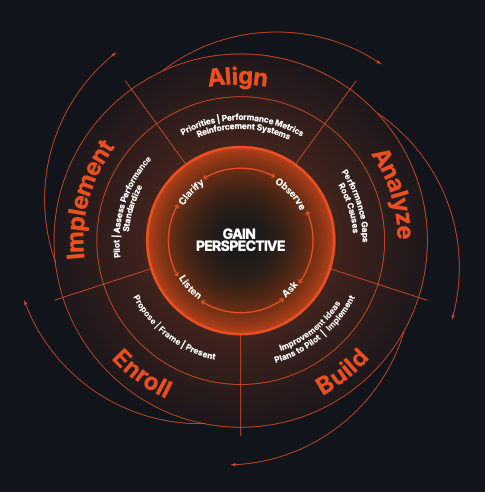
These steps follow The Intrapreneurship Journey, the framework Brent and I developed. Gaining Perspective sits at the center and continues across five connected dimensions. In Align, we connect the idea to organizational priorities, metrics, and what gets rewarded. In Analyze, we work to understand the performance gap and its root causes. In Build, we develop options with others and consider the value, resources, and risks involved. In Enroll, we help the people whose support we need understand the recommendation and have confidence in it. In Implement, we put the idea into practice, assess what happens, and adapt.
If you want to go deeper on understanding the world of the person deciding, see how to influence without authority.
What are the biggest mistakes people make when building support?
- Going straight to the top. That was my mistake at ASU. The person with the formal power may not be the person responsible for that part of the work.
- Bypassing the people whose work is affected. If you skip them, the person at the top will usually ask them anyway.
- Asking colleagues for real work without your manager. A few questions are fine. Time on a project is your manager’s decision too.
- Developing it alone. Once the alignment is clear, the next question is whether you developed the idea alone or involved others. Did you seek different perspectives and use that input to improve the idea?
- Bringing people in too late. At Ashoka, I would have invited people into the work much sooner, while their input could still change it.
- Ignoring timing. Gauge whether the moment is right, and whether your manager and teammates are in a position to listen.
Try it this week
Pick one thing you have noticed that could work better. Before you do anything else, check informally with one or two colleagues whether they see it too.
Then, in your next conversation with your manager, share what you noticed and ask: “Can I dedicate some time to understanding this better, speak with these people, and come back with what I learn?” Afterward, write down who your manager suggests you speak with, and whose responsibilities the idea touches. That list is where your support starts.