 By
Speaking up at work does not have to happen all at once, in front of everyone. Much of it happens before the meeting: conversations that help you understand other perspectives, involve the right people, and make room for your point. In the meeting, be clear whether you are sharing an observation, opening a discussion, or asking for a decision. Raise a missing perspective before a decision is made, hold your ground politely if you are talked over, and follow up afterward. You do not need to become louder. You need to be prepared, clear, and persistent.
In this article
- Set the table before the meeting
- How do I speak up at work?
- How do I speak up in meetings when I am not the loudest person in the room?
- Is it safe to speak up at work?
- What if I am not sure I am right?
- What do I do when I get talked over?
- Follow-up is king
- What are the biggest mistakes quiet people make?
- How to speak up at work, step by step
- Try it before your next meeting
This is written for the person in the meeting who has something worth saying and watches the moment pass.
Set the table before the meeting
For me, an important part of speaking up happens beforehand. You set the table before the meeting, and then, in the meeting, you eat.
Those previous conversations help you understand the different perspectives, involve the right people, and make room for the point you want to discuss.
You might discover that the topic needs a bigger conversation. Then you can work with the person leading the meeting to make sure there is time for it and that the people who need to contribute are there.
Setting the table gives people a better starting point. There still needs to be room in the meeting for questions, disagreement, and things you had not considered.
An illustrative example. Imagine you have noticed that customer complaints about delivery times keep landing with your team, but nobody owns them. Rather than raising it cold in the weekly meeting, you talk first with two colleagues who see the same complaints, and then with the person who runs the meeting. They agree it deserves ten minutes next week and suggest inviting someone from operations. When the item comes up, the right people are in the room, and you are not the only voice describing the problem.
How do I speak up at work?
Start with perspective rather than with your answer. Our For Professionals page describes the shift we teach as moving “from starting with your answer” “to starting with perspective.”
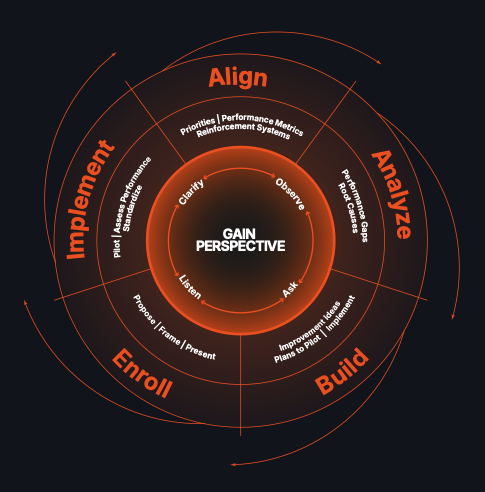
In practice, that means using the four actions of what our framework calls Gaining Perspective. Observe what leaders focus on, measure, and reward. Ask thoughtful questions to deepen understanding of processes and people. Listen to learn, not simply to answer. Clarify that what you heard is what they meant. Asking, listening and clarifying all happen out loud, and none of them needs the loudest voice in the room.
When you do make a point, connect it to something the people in the room already care about. A question I ask about any idea is: “How does it support what the organization is already trying to achieve?” That is what makes what you say count. In our framework, it is the work of Align: understanding the priorities, metrics, and what gets rewarded where you work.
Brent Martini, my partner in developing The Intrapreneurship Journey, puts it this way in our first article: “Something that seems obvious to me may not yet be obvious to them. When they can see how a change would make things better for them, they have a reason to consider it.”
Free guide
Get the free framework
Download our 12-page guide to The Intrapreneurship Journey and explore an approach to developing ideas and building support at work.
Download the free frameworkHow do I speak up in meetings when I am not the loudest person in the room?
Be clear about what you are asking for. Are you sharing an observation, opening a discussion, or asking for a decision? Saying which one helps people respond to what you actually need.
If you have not done the preparation, you can still introduce something in the meeting. You might say: “We’ve noticed something that could be worth exploring. We’re having a few conversations about it, and I’d like to bring it back for discussion next time.”
That can be an update without becoming an invitation for everyone to solve the whole issue right then.
Of course, if a decision is being made and an important perspective is missing, bring that up before the decision is made. Every decision needs the right perspectives in it. You can ask a question or flag something without having a perfectly developed alternative.
Do I have to become louder?
No. You do not have to make your entire contribution in one moment in front of everyone. You can build the conversation over time.
Our For Professionals page describes what to aim for instead: to “be known not only as someone who completes assignments, but as someone who sees the bigger picture, asks better questions, exercises sound judgment, and helps others make progress.”
Is it safe to speak up at work?
It depends on where you work, and you are right to weigh it. Preparation helps: when the people involved have already heard your point and had a chance to shape it, raising it in the meeting is less of a surprise for everyone.
Leaders carry part of the responsibility here. As I wrote in what intrapreneurship is and why it matters, giving thoughtful feedback, explaining decisions and sharing credit are the responses that matter: “These everyday responses help people decide whether speaking up and making the effort will be worthwhile.”
If speaking up is consistently unsafe where you are, that is not something you can fix alone with better wording. I wrote about where that line sits in office politics.
What if I am not sure I am right?
Then ask rather than assert. A question invites the room to think with you.
Our guide describes two of the actions of Gaining Perspective in a way that fits here: “Listen: brilliantly to learn, absorb, and appreciate, but not simply to answer” and “Clarify: that what you heard is what they meant.”
You do not need certainty to flag something. You can ask a question or flag something without having a perfectly developed alternative.
What do I do when I get talked over?
You can acknowledge the other person and still ask for room to finish. For example: “Hey, I hear what you’re saying. Please let me finish this thought, and then we can come back to your point.”
Or, more directly: “Please let me finish. Let me make the case, and then I’d like to hear what you think.”
Sometimes one clear reminder is enough for someone to realize what they are doing. But if it keeps happening, you may need to address the pattern.
You can also bring attention back to how the group is having the conversation: “Can we make sure we’re listening to one another and that everybody gets a chance to share?”
If there are agreed ground rules, ask to return to them. If there are no clear agreements, this can be a good moment to suggest one: let people finish before responding.
The person leading the meeting has a responsibility here too. They can make room for someone to finish and help the group hear perspectives that might otherwise get lost.
If one person repeatedly talks over you, there may also be a difficult conversation to have afterward. Name what you noticed, explain how it affects your ability to contribute, and ask for a specific change. You can be respectful and direct: “I want to hear your perspective, and I also need the space to finish mine.”
Follow-up is king
A useful thought can be shared before, during, or after a meeting. But if we want something to happen, we need to follow up. Send the information you promised, speak with the person who needs to hear it, and make sure the next step is clear.
Two questions I find useful are: “Who else should hear this?” and “Who else should I talk to?” Those are skillful questions. They help you discover whose perspective is still missing and how to involve them. I wrote more about finding those people in who to involve first when building support.
Ultimately, when people understand one another and work together better, decisions can move forward with a stronger foundation.
What are the biggest mistakes quiet people make?
- Treating the meeting as the only chance. Much of the work happens before it, and the rest happens in the follow-up.
- Not saying what they are asking for. An observation, a discussion and a decision need different responses.
- Staying silent while a decision is made without a perspective it needs. Flag it, even without a full alternative.
- Letting a pattern continue. One interruption can be handled in the moment. A repeated one needs a conversation.
- Not following up. Without it, a good point fades.
- Giving up. At Ashoka, with an idea I believed in, I “kept trying to move it forward, became frustrated, and eventually gave up.” Looking back, I needed to bring people into it, not to stop.
How to speak up at work, step by step
- Before the meeting, talk to two or three people about the point you want to raise, and ask what they see.
- Talk to the person leading the meeting if the topic needs time, and ask who else should be there.
- In the meeting, say what you are asking for: an observation, a discussion, or a decision.
- If you are talked over, ask to finish, and if it repeats, address the pattern afterward.
- After the meeting, follow up with what you promised, and ask, “Who else should hear this?”
These steps follow The Intrapreneurship Journey, the framework Brent and I developed. Gaining Perspective sits at the center and continues across five connected dimensions. In Align, we connect the idea to organizational priorities, metrics, and what gets rewarded. In Analyze, we work to understand the performance gap and its root causes. In Build, we develop options with others and consider the value, resources, and risks involved. In Enroll, we help the people whose support we need understand the recommendation and have confidence in it. In Implement, we put the idea into practice, assess what happens, and adapt.
Try it before your next meeting
Pick one point you would normally keep to yourself in your next team meeting. In the days before, mention it to one colleague and to the person who leads the meeting, and ask, “Who else should hear this?”
In the meeting, say plainly whether you are sharing an observation, opening a discussion, or asking for a decision. Afterward, send one follow-up message, and note how differently the point landed compared with the last time you raised something cold.