 By
There is no guaranteed way to get promoted. What you can do is give people more reasons to trust you with greater responsibility. Do your current job well, then look beyond it: find where you could add value to the priorities your team and its leaders already have, and help make that happen with others. Whether that turns into a promotion also depends on the organization. When it does not, have the conversation and listen to the reasons.
In this article
- The workshop nobody assigned me
- How do I get promoted?
- Why am I not getting promoted?
- Why do high performers not get promoted?
- How do I bring an idea forward so it builds trust?
- Brent’s perspective on what a yes requires
- What to do if you’re passed over for a promotion?
- What are the biggest mistakes people make when they want more responsibility?
- How to start building that trust
- Try it over the next two weeks
The clearest example I have of this did not start with a request for more responsibility. It started with a workshop nobody had asked me to design.
The workshop nobody assigned me
This showed up clearly during my Ashoka days. Our CEO, Bill Drayton, kept going on and on about a strategy called the four drivers. These were four programs he believed would be central to the organization, especially to the Youth Years team.
The strategy was still new. There was confusion, and people were not fully on board yet. From where I sat, some of these ideas were sitting in a parking lot while Bill kept talking about them.
At the time, I was managing the U.S. part of a partnership between Ashoka and Boehringer Ingelheim. We were helping the company bring a culture of innovation into its organization. The company wanted training for its staff, and I saw an opportunity to run a workshop called “Your Kids.” It supported parents in helping their kids make positive change, and it was connected to one of the drivers Bill kept talking about.
Designing that workshop was not a task I had been given. I checked in with my manager and suggested that this could fit the company’s training needs while also helping us put one of the drivers into practice. She gave her blessing, and I went ahead and did it.
My manager also recorded a short video of the session. We shared it with Bill. The message was essentially: “Hey, we did one of the drivers. Here is what happened.”
The next day, I received an invitation to join an executive team meeting and explain how it had gone. Bill put me in the spotlight and highlighted the work as an example for others.
After that, I started being invited to more and more meetings with him. He trusted me with more responsibility, including helping move the other drivers forward. I became involved in supporting the strategy globally and helped co-found an Ashoka youth program in the United States.
The biggest change was proximity to the CEO. I was closer to the conversations, understood more of what he was trying to accomplish, and had more opportunities to contribute. There was formal progression too. Ashoka held promotion conversations once a year, and I received a promotion in title and an increase in salary each year. But the shift in access, trust, and responsibility was especially important to me.
I had been listening to what mattered to Bill. I saw a way to connect that with what our partner needed, worked with my manager, and took a couple of extra steps to make it happen. That workshop showed that I cared about the priorities he kept discussing and was willing to help move them forward.
How do I get promoted?
I think about promotion in two ways: linear promotion and exponential promotion.
Linear promotion is when you go from A to B to C to D. You fulfill your job description, do your work well, build your capabilities, and progress along the expected path.
Exponential promotion is what I call the possibility of going from A to F. You look beyond your job description and ask where you could add value to the team and the priorities they already have. You see something that could be better, take the initiative, and help make it happen. That can change how people see you. They begin to recognize that you could contribute in ways they had not previously considered.
Both are real paths, and neither is guaranteed. As we say on our For Professionals page, our approach “cannot guarantee a promotion, a title, or a particular career outcome.” Doing valuable work beyond your role gives people more reasons to trust you with greater responsibility. Whether that turns into a promotion also depends on the organization.
Sometimes this requires some hustling on your own time, especially if the company culture does not have time allocated for people to explore improvements. You may decide that an opportunity is worth investing some extra time and energy in. But be thoughtful about what you take on. The work should help you grow and contribute. You do not need to keep accepting more and more work indefinitely.
Free guide
Get the free framework
Download our 12-page guide to The Intrapreneurship Journey and explore an approach to developing ideas and building support at work.
Download the free frameworkWhy am I not getting promoted?
There is a reason, or a few reasons, why it is not happening. Maybe people do not see the value you are bringing. Maybe their expectations are different from yours. Maybe there is no budget. Sometimes a person may feel threatened by you. But you cannot assume you know what is going on without trying to understand it.
You need to have the conversation and really listen to the reasons. Being able to talk about promotion, pay, disappointment, and your own ambitions is part of taking on greater responsibility. These conversations can be uncomfortable, and we need to learn how to navigate them.
Why do high performers not get promoted?
Strong performance is necessary, and it is not always the whole case. “Doing your job well matters. It is the foundation of trust,” as we put it on our For Professionals page. “Greater responsibility requires more than reliability. It requires perspective, judgment, collaboration, initiative, and the ability to help important work move forward.”
Doing your job well keeps you on the linear path. The people deciding on a bigger role are also asking whether you can help with what they are responsible for, beyond your own tasks. You do not have to wait for a promotion to begin showing that.
A lot of promotion advice says to make yourself more visible. Visibility can help, and in my Ashoka story the video mattered. But it made real work visible. The goal, as we put it, “is not to get noticed for having ideas. It is to become trusted for moving the right ideas well.”
How do I bring an idea forward so it builds trust?
Start where the person deciding starts: with what they are trying to achieve. A common piece of advice is to bring a solution whenever you raise a problem. Harvard Business School Online’s guide to getting promoted puts it this way: “When you raise an issue to your boss, also propose a solution.”[1] I agree, and I would add what comes before the solution.
In our framework, that starts with Align: understanding what leaders are responsible for, how their performance is measured, and what they are rewarded for. That includes the leader as a person. Will this help the leader meet their goals, strengthen their performance, or advance in their role? Connect the benefit to the individual leader with the benefit to the organization as a whole.
Then a leader will want to know three more things:
- Who was involved in developing it? Did you speak with colleagues, and with the people whose work would be affected?
- What work was done before arriving at it? How did you identify the problem? What did you learn from the people involved? Did you look at what had been tried previously and what happened?
- Does it address the root cause, and is the return worth the investment? The investment includes staff time, capacity, and other resources, and risk sits alongside the costs and benefits.
When you have done that work, you can say what our For Professionals page describes: “Here is what matters, what we learned, what we recommend, who helped shape it, what it will require, and how we can test it responsibly.”
Brent’s perspective on what a yes requires
Brent Martini is a former Fortune 50 executive and former president of Bergen Brunswig Drug Company. He is also my partner in developing The Intrapreneurship Journey, and he has been the person deciding which ideas receive attention, resources, and support.[2] Here is how he sees the preparation behind a recommendation, and why it matters for someone who wants more responsibility.
Edited for length and clarity.
Brent: That preparation has real value. It gives me something I can evaluate and support with confidence. It also shows that the person understands what a yes requires. Other people will need to commit time and change how they work. As the sponsor, I am putting my own credibility behind the recommendation.
There is a longer-term benefit too. People who learn to think this way are developing the judgment to take on greater responsibility. They learn to consider the whole organization and involve the people who will have to make a change work. That is how you begin developing your next generation of leaders.
For me, the value is having more people able to contribute to the organization’s success before they have the authority to make decisions themselves. Leadership has a responsibility in that relationship: make the priorities clear, take people’s work seriously, and provide support for well-considered recommendations.
What to do if you’re passed over for a promotion?
If you are contributing at a higher level but still are not being promoted, you have to be willing to have difficult conversations. I would approach it through the same discipline we teach:
- Gain Perspective. Understand how your manager sees your contribution, what they expect from someone in the next role, and what may be preventing the decision. Ask questions, listen, and clarify.
- Build your case. Look at how you have contributed. Analyze what has worked and what has not. What responsibilities have you taken on? What results can you point to? How has your work helped the team and its priorities?
- Enroll them. Explain why a promotion or change in compensation makes sense. Be clear about what you are asking for, and work toward a concrete next step.
You should be able to say: “Here is what I am doing. Here is what is working. Here is where my responsibilities have grown. I would like us to talk about what that means for my role and compensation.”
Then find out what would need to happen, who makes the decision, and when you will revisit it. You need enough clarity to know what you are working toward.
It also helps to understand your position. In a negotiation, you need to understand the value you bring and the options you have. Part of your position is the work you are doing and making sure that work is seen. Part of it is understanding what the organization would lose if you left. And part of it is having real alternatives, so you can make a decision about your future. You can communicate your value clearly and respectfully. You can also recognize when continuing to give more is no longer the right choice for you.
Should I quit if I don’t get promoted? Not before you have had the conversation. If you have had the difficult conversations, listened to the feedback, and still do not feel valued or see a credible path forward, you should be able to say: “I do not want to work here anymore.” Start making plans. Explore other opportunities. Build options before deciding your next step.
One organization may not have the willingness or ability to support your growth. There may be another team where your contribution is needed and appreciated. The capabilities you build through this journey go with you: your ability to gain perspective, work with people, move ideas forward, have difficult conversations, and take responsibility for your own growth.
What are the biggest mistakes people make when they want more responsibility?
- Assuming you know why it is not happening. The reason might be how your work is seen, different expectations, budget, or something else. You only find out by asking and listening.
- Starting with what you want instead of what they are trying to achieve. First you Align. The workshop mattered because it connected to something Bill kept talking about.
- Leaving your manager out. My manager gave her blessing, recorded the session, and helped make the work visible. We were working together.
- Treating visibility as the goal. Being noticed for ideas is not the same as being trusted to move them.
- Taking on more and more indefinitely. Choose the extra work that helps you grow and contribute, and be thoughtful about the rest.
- Waiting for the title. As our For Professionals page puts it, “Your title does not have to change before your leadership does.”
How to start building that trust
- Listen for what leaders keep talking about. What are the people leading your organization trying to accomplish? Which priorities come up again and again?
- Find where it meets your work. Look for a place where something you already do, or someone you already serve, could help move one of those priorities.
- Bring your manager in first. Explain how the idea could fit your team’s work and their priorities, and ask for their perspective before you go further.
- Do it with care, and make the result easy to share. A short summary, a few numbers, or a video like ours gives a leader something concrete to see.
- Decide what you will not take on. Protect the work that matters most in your current role, because that is still the foundation of trust.
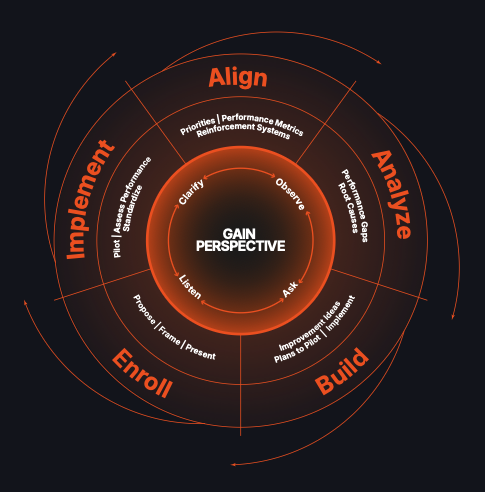
These steps follow The Intrapreneurship Journey, the framework Brent and I developed. Gaining Perspective sits at the center: observing, asking thoughtful questions, listening to learn, and clarifying shared understanding. It continues across five connected dimensions. In Align, we connect the idea to organizational priorities, metrics, and what gets rewarded. In Analyze, we work to understand the performance gap and its root causes. In Build, we develop options with others and consider the value, resources, and risks involved. In Enroll, we help the people whose support we need understand the recommendation and have confidence in it. In Implement, we put the idea into practice, assess what happens, and adapt.
Try it over the next two weeks
For the next two weeks, write down what the leaders around you keep talking about: in team meetings, updates, and conversations with your manager. At the end, pick the one that comes up most.
In your next one-on-one, ask your manager which of these matters most to them right now, and where you could help. Afterward, note whether their answer connects to anything you already do, and what one small, concrete contribution could look like. That is where my workshop started.