The mistakeis leading with the solution.
"This tool will give us a better dashboard." Everyone has said a version of that sentence, and it is the most common reason a good idea gets a polite no.
The sentence is not wrong. It is just answering a question nobody asked. A leader hearing it has to do the translation work themselves: what would this improve, does that improvement matter here, and how much of my attention is it worth. Most will not do that work on your behalf, not out of indifference but because they are doing it for a dozen other things already.
The version that lands does the translation first. "This dashboard will help account teams identify renewal risk thirty days earlier, supporting the company's retention priority." Same tool. Same person proposing it. The difference is that the second version arrives already connected to something the organization has committed to.
It is not agreement, and it is not enthusiasm. Someone can like your idea and still have no route to funding it. Alignment is a demonstrable connection to a commitment that already exists.
What alignment actually means
Alignment is not agreement, and it is not enthusiasm. It is a demonstrable connection between your idea and something the organization has already committed to. Sometimes that connection is obvious. More often it is not, and the work of finding it is the work of this Dimension.
Three things have to be understood before an idea can be described as aligned, and they are not interchangeable.
Anchored in Gaining Perspective
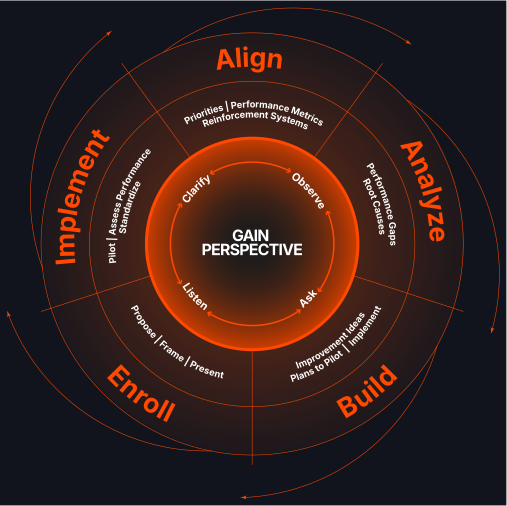
Align is not a research task you complete alone at a desk. Priorities are found by observing what leaders repeatedly discuss and fund. Metrics are found by asking. Reinforcement systems are usually found by listening to what people say about what actually gets rewarded, which is not always what the policy says.
1 · Priorities
What is receiving attention
The outcomes receiving the greatest leadership attention: growth, cost, customer satisfaction, safety, quality, speed, retention, compliance, or another strategic goal.
2 · Performance metrics
What shows movement
The visible and contributory measures that show whether the organization, team, process or person is moving toward those priorities.
3 · Reinforcement systems
What shapes behavior
What is rewarded, recognized, promoted, funded, corrected or punished. These systems shape behavior, sometimes more strongly than the stated priority.
A stated priority tells you what an organization says it wants. A reinforcement system tells you what it will actually do. When the two disagree, behavior follows the reinforcement, and an idea aligned only to the stated priority runs into a wall nobody will name out loud.
Create a line of sight
Enterprise priorities cascade into contributory measures, and those measures shape everyday work. The job is to show where your idea joins that chain, in language the organization already uses.
Common mistake
"This tool will give us a better dashboard." The idea is framed around the solution, not the outcome.
Better move
"This dashboard will help account teams identify renewal risk thirty days earlier, supporting the company's retention priority."
Can you draw a clear line from the idea to a priority, from the priority to a metric, and from the metric to the behavior the organization is reinforcing? If not, the idea may be interesting, but it is not yet aligned.
A worked example
A people leader wants to introduce a peer-recognition platform. The idea does not change. What changes is what the idea is about.
Weak alignment
"Employees will enjoy recognizing each other."
Stronger alignment
"Voluntary turnover in the first year is above target. Our engagement data shows that employees who report frequent recognition are more likely to stay. We propose a ninety-day pilot in two high-turnover teams, measured against recognition frequency, engagement, and retention."
The platform is no longer the idea. The idea is improving an important outcome, and the platform is one way to do it. That shift is what makes the proposal answerable rather than merely agreeable.
Alignment makes the idea relevant before it makes the idea impressive.
When the stated priority and the real one disagree
Every organization publishes a list of priorities. Every organization also rewards, promotes, funds and corrects behavior, and the two do not always point the same way. When they disagree, behavior follows the reinforcement, every time.
This is the part of Align people skip, and it is the part that explains ideas which were aligned on paper and still went nowhere. A proposal that serves the stated priority but costs someone against the measure they are actually judged on will lose, and nobody involved will say that out loud, because saying it out loud means describing the organization accurately in a meeting.
Finding the reinforcement system is listening work rather than research work. It is what people say about what actually gets someone promoted here, which recovery from a mistake was forgiven and which was not, and what the last person who proposed something similar experienced afterwards.
"If this worked, who would get credit for it, and who would carry it if it did not?" The answer tells you more about whether the idea can move than any amount of analysis of the idea itself.
Where to look
- What gets celebrated in all-hands meetings, and what gets mentioned quietly
- Which numbers appear in every deck, regardless of the topic
- What senior people ask about first when something goes wrong
- Which teams have grown headcount and which have not
Starbucks, 2008: a smaller set of priorities
Starbucks' public transformation agenda aligned many different actions around a small number of priorities: restore coffee authority and the Starbucks Experience, improve US store-level economics and operational discipline, make growth more sustainable rather than merely faster, and re-engage partners while strengthening customer connection.
The actions varied enormously, covering training, products, stores, loyalty, equipment and cost structure. They were not random. They were organized around what the business needed most, which is what alignment looks like at enterprise scale.
Read from the public record. Starbucks did not use or endorse this framework, and the case mapping is interpretive rather than a causal claim.
The point of the example is not the size of the company. It is that a long list of unrelated good ideas is weaker than a shorter list organized around what matters most, and that is as true for one proposal as for a transformation agenda.
Common questions
- What does Align mean in the Intrapreneurship Journey?
- Align is the first Dimension. It means connecting your idea to what the organization already cares about: the priorities receiving leadership attention, the performance metrics that show movement against them, and the reinforcement systems that shape everyday behavior.
- How do I know whether my idea is aligned?
- Try drawing a line from the idea to a priority, from the priority to a metric, and from the metric to the behavior the organization is reinforcing. If any link in that chain is missing, the idea may be interesting but it is not yet aligned.
- Why are reinforcement systems treated separately from priorities?
- Because they often disagree. A stated priority tells you what an organization says it wants. What is rewarded, promoted, funded or corrected tells you what it will actually do, and behavior follows the reinforcement.
- What if my idea does not connect to an existing priority?
- Then it is probably not worth pursuing yet. The best new idea is one that clearly has a line of sight to contributing to something the organization is already trying to achieve.