The mistakeis defending the idea you arrived with.
By the time most people reach this point they have been carrying one idea for weeks. It is theirs. It is the reason they started. And it is now the thing most likely to stop them.
A single option asks a leader to say yes or no. A set of options asks them to choose, which is a conversation rather than a verdict, and it changes what the meeting is about. It also answers, before anyone asks it, the question that quietly decides most proposals: was this considered properly, or am I being shown the first thing somebody thought of?
The discipline is not to abandon your idea. It is to make it earn its place against three or four others generated with people who know things you do not.
Not a hostile question. It is how a decision-maker checks whether they are looking at a conclusion or being sold one. Having a real answer is often the difference between sponsored and deferred.
Open the field before you narrow it
The instinct at this point is to defend the idea you arrived with. That instinct costs more than it saves. A single option asks a leader to say yes or no. A set of options asks them to choose, which is a conversation rather than a verdict, and it tells them the work was done properly.
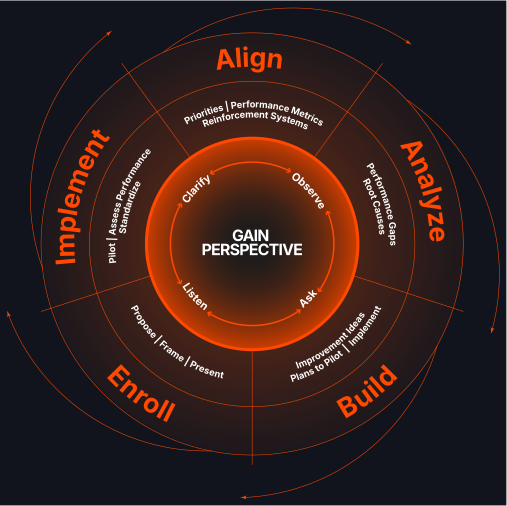
Building is the moment to open the field, involve people with relevant experience, and create enough options to learn what a strong recommendation really looks like.
A disciplined brainstorm
- Open the field before narrowing it: incremental, structural, behavioral, technical and policy options.
- Invite the people closest to the work to improve, challenge and combine ideas.
- Separate idea generation from evaluation, so practical concerns do not close the field too early.
- Return to the priority and the root cause, because a creative idea that improves neither is a distraction.
- Preserve the alternatives, because leaders often ask what else was considered and why the recommendation is stronger.
"What else did you consider?" is not a hostile question. It is how a decision-maker checks whether they are being shown a conclusion or being sold one. Having a real answer is often what separates a proposal that gets sponsored from one that gets deferred.
Evaluate through the eyes of decision-makers
Cost-benefit and risk-return analysis is the floor, not the ceiling.
Alongside the classic numbers, the framework weighs the needs and criteria of different stakeholders, leaders' varied appetites for change and investment, timing within the fiscal year, brand risk and preservation, and how risk would actually be mitigated. An option that scores best on return can still be the wrong recommendation if it lands in the wrong quarter or exposes something the organization protects.
Not simply a promising idea, but a complete, credible proposal co-developed with, and increasingly owned by, the people needed to bring it to life successfully.
Build the path to pilot
Leaders need enough detail to believe the team can execute, without pretending every answer is known. A proposal becomes more credible when it includes a bounded way to learn. The pilot plan should reduce exposure, produce meaningful evidence, and reveal what must be strengthened before scale.
Scope
Where will we test, with whom, and for how long?
Owners
Who is accountable, who contributes, and who decides?
Measures
Which leading and lagging metrics show progress?
Support
What training, communication, tools and leadership support are required?
Risks
What could harm customers, people, operations, brand or compliance?
Learning
What questions must the pilot answer before expansion?
Thinking ahead is rarely viewed as a negative by those in power. Over-planning an unapproved idea can be.
The balance to hold
Enough plan that a leader can see it working. Not so much plan that you have spent three months and considerable political capital on something nobody has agreed to yet.
The pilot design is usually the right level of detail: specific about the first bounded test, honest about what it is designed to find out.
A worked example: reducing product returns
The team builds alternatives before selecting a pilot.
The pilot combines the strongest low-risk elements without locking the organization into a full redesign. Option C is not dismissed. It is held, with a reason, for a decision that has better evidence behind it.
How much planning is the right amount
Thinking ahead is rarely viewed as a negative by those in power. Over-planning an unapproved idea can be.
Both halves of that sentence matter. Arrive with no plan and you are asking someone to fund an intention. Arrive with a fully specified twelve-month program for something nobody has agreed to and you have signalled two unhelpful things: that you have spent significant time on a decision that was not yours to make, and that you may be difficult to redirect.
The pilot design is almost always the right altitude. It is specific enough to show the work is real, bounded enough that agreeing to it is a small decision, and honest about what it is designed to find out rather than what it is designed to prove.
Could a leader say yes to this in the meeting, without needing to consult anyone or find budget they do not control? If not, you have either aimed at too large a first decision or done too little to reduce it.
What a leader is checking
- Is the exposure bounded, and do I understand the downside
- Does the team know what would count as this not working
- Who is actually going to do it, on top of what
- What do we learn even if the answer is no
Starbucks, 2008: a portfolio, not one heroic solution
The 2008 transformation agenda combined customer-facing, partner-facing, portfolio, product, equipment, loyalty and cost actions. Each addressed a different part of the system.
Experience
Espresso excellence training for US company-operated store employees.
Product
Launch Pike Place Roast, ground in stores and brewed frequently.
Equipment
Deploy Mastrena espresso machines to support quality and consistency.
Customer
Introduce Starbucks Card Rewards and strengthen customer connection.
Portfolio
Slow US openings and close roughly 600 underperforming US stores.
Economics
Improve labor efficiency, supply chain performance, waste, and non-store support costs.
Read from the public record. Starbucks did not use or endorse this framework, and the case mapping is interpretive rather than a causal claim.
The logic of the portfolio was stronger than any single action: restore the experience, improve the economics, and make growth more sustainable. No one item on that list would have been a sufficient recommendation on its own.
Common questions
- What does Build mean in the Intrapreneurship Journey?
- Build is the third Dimension. It means developing a credible, actionable recommendation by opening the field of possible remedies with the people who have relevant experience, evaluating options through the eyes of decision-makers, and designing a bounded path to pilot.
- Why generate several options instead of recommending one?
- Because a single option asks a leader to say yes or no, while a set of options invites a decision. Leaders also routinely ask what else was considered, and having a real answer is often what separates a proposal that gets sponsored from one that gets deferred.
- How much detail should a proposal include?
- Enough for a leader to believe the team can execute, without pretending every answer is known. Thinking ahead is rarely viewed as a negative by those in power. Over-planning an unapproved idea can be.
- What belongs in a pilot plan?
- Scope, owners, measures, support, risks and learning questions. The pilot should reduce exposure, produce meaningful evidence, and reveal what must be strengthened before scale.