The mistakeis treating approval as the finish line.
It is the most understandable error in the whole Journey. You have spent months getting to yes. Yes arrives. It feels like the work is done, and the natural next move is to announce a date.
But the people who agreed are not the people who now have to change what they do on Monday, and that second group has had none of the conversations that convinced the first. What they receive is a decision, made elsewhere, about their work. Which is roughly where you were at the start of this whole process, on the other side of it.
Approval does not remove resistance. It changes who must now understand, trust and own the new way. So implementation begins exactly where the Journey began, with the same discipline, applied to different people.
You spent the earlier Dimensions asking a leader to understand your world. Implementation is where you owe the same to everyone the change lands on.
Approval does not remove resistance
It changes who must now understand, trust and own the new way. The people who were persuaded are rarely the people who have to live with the change, and the second group has not had the benefit of the conversation the first group had.
So the first task is not to announce a launch date. It is to gain the perspective of the people who will carry the change, be measured by it, support it, or experience its effects. Four questions are running in their heads whether or not anyone asks them out loud.
What does this mean to me?
Role, workload, customer interaction, authority and expectations.
What will change?
Which old behaviors stop, which new behaviors begin, and what stays the same.
What do I need to learn?
Knowledge, skills, practice, tools, judgment and new measures.
Who will help me succeed?
Manager support, expert help, feedback loops, resources and escalation paths.
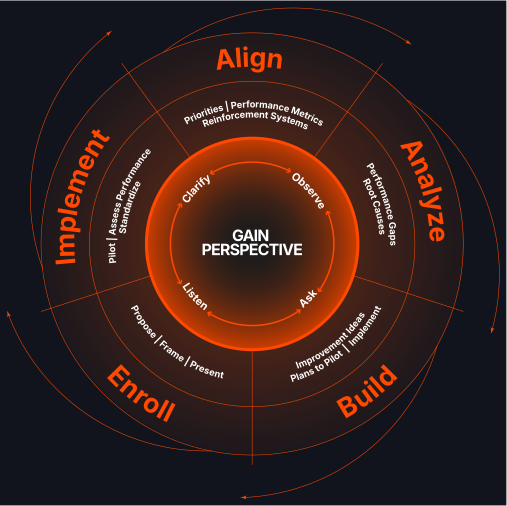
The anchor does not switch off once an idea is approved. Implementation begins with exactly the same discipline that began the Journey, applied to a different group of people.
Implementation also means re-enrolling customers and other stakeholders. People need to understand what is happening, why it matters, what to expect, and how they can influence what happens next.
Pilot. Assess. Decide. Standardize.
A pilot is not a smaller launch. It is a disciplined learning environment.
- Pilot. Test the new way in a contained but representative setting.
- Assess. Use priority metrics, new measures, observation and participant feedback.
- Decide. Is the new way working well enough, and do we understand why?
- Iterate or standardize. Adjust and test again, or embed the new way in roles, systems, procedures, training and reinforcement.
Not yet
Return to Analyze. Review root causes, execution and assumptions. Modify and test again.
Working
Standardize the process, train others, update measures, and reinforce the new behaviors.
A pilot that improves the number without explaining the mechanism cannot be scaled safely. You would be repeating something you cannot describe, in a setting that may not behave the same way.
A worked example: a five-store pilot
The plan is designed to answer questions, not merely to prove the team was right.
The pilot succeeds when it produces both better performance and better understanding. The decision rule is written before the results arrive, which is what stops a disappointing outcome from being reinterpreted after the fact.
Why a pilot fails safely and a launch does not
A pilot is not a smaller launch. The difference is not size, it is what the thing is for.
A launch is designed to work. A pilot is designed to produce information, including information you would rather not have. That changes what you build, what you measure and what you agree in advance. It also changes what happens when the numbers disappoint: a launch that underperforms is a failure someone has to own, while a pilot that underperforms has done its job and sent you back to Analyze with something you did not know before.
The single practice that makes the difference is writing the decision rule before the results arrive. Scale only if this improves without unacceptable workload or customer disruption. Once that sentence exists in writing, a disappointing result cannot quietly be reinterpreted afterwards, which is what happens to most pilots that were really launches.
A pilot succeeds when it produces both better performance and better understanding. Improving the number without being able to explain why is not a result you can safely scale.
Agree these before you start
- What we are trying to learn, not only what we hope to prove
- Which measures are leading and which are lagging
- What would count as this not working
- Who decides, and when
- What happens to the people involved either way
Starbucks, 2008 to 2010: execution across the whole system
The company closed underperforming stores and reduced infrastructure costs, retrained baristas and strengthened the coffee experience, launched new products and customer rewards, improved labor efficiency and supply chain performance, and re-engaged store leaders around a clearer mission.
Implementation was system-wide. People, process, portfolio, product, customer connection and economics moved together.
Read from the public record, using the periods and segments Starbucks reported. Starbucks did not use or endorse this framework. The turnaround was not a straight line and the results cannot be attributed to any one action. These are case indicators, not causal proof.
What the case illustrates is the logic of a complete Journey rather than the effect of a single decision: understand the real situation, align around what matters, act across the system, enroll people in the change, and measure whether the new way is working.
The end of a cycle, not the end of the Journey
A new way becomes part of organizational history. Scaling it may require another Journey, and the next person to propose something will be working inside the system you just changed. That is not a failure of the method. It is the method.
Bringing a new way into an existing system can require as much work as developing it in the first place, or more. Shared ownership becomes actionable through clear roles, responsibilities, expectations and support.
A completed cycle
- The idea is aligned with a real priority.
- The performance gap and root causes are credible.
- The recommendation is co-created and complete enough.
- Leaders and stakeholders trust the new way.
- A pilot produces evidence and learning.
- The new way is standardized in process, roles, measures and training.
Common questions
- What does Implement mean in the Intrapreneurship Journey?
- Implement is the fifth Dimension. It means turning an approved idea into shared action: gaining the perspective of the people who will carry the change, then piloting, assessing performance, deciding, and either iterating or standardizing.
- Why does implementation start with perspective rather than a plan?
- Because approval does not remove resistance, it changes who must now understand, trust and own the new way. The people who have to live with the change have not had the conversation that persuaded the decision-makers.
- What is the difference between a pilot and a small launch?
- A pilot is a disciplined learning environment. It is designed to answer questions rather than to prove the team was right, with learning questions and a decision rule set before the results arrive.
- What happens if the pilot does not work?
- Return to Analyze. Review the root causes, the execution and the assumptions, then modify and test again. A pilot that does not work has produced information, which was part of its job.